
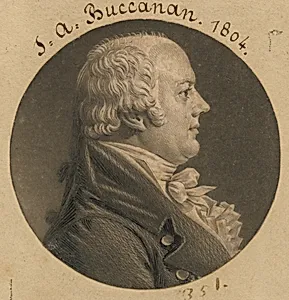
James A. Buchanan
Medium
Classification
Department
Smithsonian Collection
Museum
Smithsonian American Art Museum
Credit
National Portrait Gallery, Smithsonian Institution; gift of Mr. and Mrs. Paul Mellon
Accession Number
S/NPG.74.39.8.22
Rights
Public Domain
Tags
Art Historical Context
This elegant 1804 print portrait, titled *James A. Buchanan*, the likeness of a prominent male merchant during the early years of the American Republic. Created by French-born artist Charles Balthazar Févret de Saintémin (1770–1852), who had emigrated to the United States amid the French Revolution, the work exemplifies his signature style of precise profile silhouettes. Saint-Mémin a mechanical physiognotrace device to trace subjects' profiles accurately, then engraved them onto copper plates for reproduction—a innovative technique that made high-quality portraits accessible to the emerging middle class. As a print from the Smithsonian American Art Museum's collection (gift of Mr. and Mrs. Paul Mellon), it reflects the cultural shift toward personal commemoration in post-Revolutionary America. Merchants like Buchanan symbolized economic ambition and stability, their images serving as both professional calling cards and family heirlooms. Saint-Mémin's methodical approach produced cameo-like vignettes that emphasized dignity and character, influencing American portraiture during a time when photography was still decades away. Today, this piece offers a window into the refined world of early 19th-century commerce and artistry.