
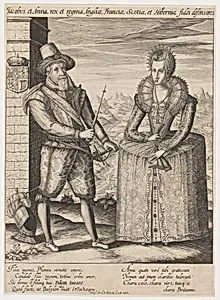
James I and Anne of Denmark
1551 to 1600
Medium
engraving
Dimensions
sheet: 35.7 × 25.8 cm (14 1/16 × 10 3/16 in.)
Classification
Department
CG-E
Museum
National Gallery of Art, Washington, D.C.
Credit
Rosenwald Collection
Accession Number
1951.11.59
Rights
Public Domain
Art Historical Context
This enchanting engraving, titled *James I and Anne of Denmark*, captures the royal couple in a period of transition for the British monarchy. Created after the Flemish master engraver Hieronymus Wier (1553–1619) between 1551 and 1600, it likely portrays James VI of Scotland—future James I of England—and his consort, Anne of Denmark. At around 35.7 × 25.8 cm, the print's intimate scale made it ideal for dissemination among the elite, serving as both a personal keepsake and a tool for royal propaganda during the late Tudor and early Stuart eras. Engraving, an intaglio technique where lines are incised into a metal plate and inked for transfer to paper, allowed Wierix and his followers to achieve exquisite detail and tonal subtlety. Wierix, part of a prolific Antwerp engraving family, excelled in reproductive prints that faithfully echoed paintings or drawings, making high art accessible beyond court circles. This method's precision highlights the regal attire, poised expressions, and symbolic elements typical of Renaissance portraiture, emphasizing lineage and divine right. Housed in the National Gallery of Art's Rosenwald Collection, this work underscores the cultural role of prints in shaping monarchical identity. Visitors will appreciate how such affordable multiples bridged the gap between palace and public, immortalizing a pivotal royal pair on the cusp of the Union of the Crowns.