
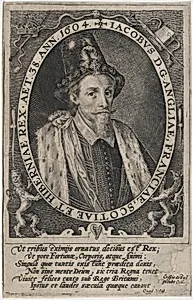
James I, King of England
published 1604
Medium
engraving
Dimensions
sheet: 14.6 × 9.4 cm (5 3/4 × 3 11/16 in.)
Classification
Department
CG-E
Museum
National Gallery of Art, Washington, D.C.
Credit
Rosenwald Collection
Accession Number
1950.14.706
Rights
Public Domain
Art Historical Context
Behold *James I, King of*, a finely wrought engraving by the renowned Dutch artist Crispijn de Passe I published in 1604 This intimate portrait, measuring just 14.6 × 9.4 cm, captures the newly crowned monarch—James VI of Scotland who ascended the English throne in 1603—during the dawn of the Stuart dynasty. De Passe, a master engraver from Antwerp, was celebrated for his detailed reproductive prints that brought the likenesses of Europe's elite to a wider audience. Engraving as a medium was revolutionary in this era, allowing for precise, reproducible images through incised metal plates. De Passe's technique shines in the delicate line work that renders James's regal attire, facial features, and dignified pose with remarkable clarity and depth. Such prints served as visual propaganda, disseminating the king's image across households and courts, fostering loyalty in an age of political transition following Elizabeth I's death. Housed in the National Gallery of Art's Rosenwald Collection (Department CG-E), this work exemplifies the cultural power of printmaking in early modern Europe. It not only immortalizes a pivotal ruler but also highlights how art bridged the gap between monarchy and the masses, making royal authority feel accessible yet awe-inspiring.
About the Artist
Crispijn de Passe I
Crispijn de Passe I, born around 1564 in Arnemuiden, Zeeland, emerged as one of the most influential Dutch engravers and print publishers of his era. He relocated to Antwerp as a youth, where he honed his craft amid the city's vibrant printmaking scene, becoming an independent master in the Guild of Saint Luke by 1584–1585. There, he worked as a reproductive engraver, primarily after designs by pr...