
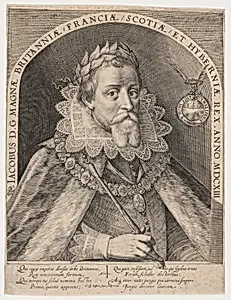
James I, King of England
Medium
engraving
Dimensions
sheet: 29.4 × 22.7 cm (11 9/16 × 8 15/16 in.)
Classification
Department
CG-E
Museum
National Gallery of Art, Washington, D.C.
Credit
Rosenwald Collection
Accession Number
1951.11.10
Rights
Public Domain
Art Historical Context
Behold *James I, King England* (1613), a finely wrought engraving by Crispijn de I, a leading Dutch engraver of the early 17th century. Passe, part of a renowned family of printmakers based in Antwerp, excelled in detailed line work characteristic of Northern Mannerism transitioning into Baroque portraiture. This sheet, measuring 29.4 × 22.7 cm, captures monarch with precision and elegance now housed in the National Gallery of Art'swald Collection. Created a decade into James I's reign (1603–1625), the print reflects the era's fascination with royal iconography. James, who united the crowns of England and Scotland, used such portraits to project authority and stability amid political turbulence, including the Gunpowder Plot aftermath. Engravings like this were vital tools for disseminating the king's image across Europe, far beyond what paintings alone could achieve. The engraving medium—incising lines into a copper plate for inked impressions—allowed for exceptional detail and multiple reproductions, revolutionizing visual culture. De Passe's technique highlights subtle textures in attire and expression, making this not just a likeness, but a window into Jacobean power and artistry. A testament to printmaking's golden age!
About the Artist
Crispijn de Passe I
Crispijn de Passe I, born around 1564 in Arnemuiden, Zeeland, emerged as one of the most influential Dutch engravers and print publishers of his era. He relocated to Antwerp as a youth, where he honed his craft amid the city's vibrant printmaking scene, becoming an independent master in the Guild of Saint Luke by 1584–1585. There, he worked as a reproductive engraver, primarily after designs by pr...