
James I
1641
Medium
engraving
Dimensions
plate: 17.4 × 12 cm (6 7/8 × 4 3/4 in.)
Classification
Department
CG-E
Museum
National Gallery of Art, Washington, D.C.
Credit
Rosenwald Collection
Accession Number
1951.11.122
Rights
Public Domain
Art Historical Context
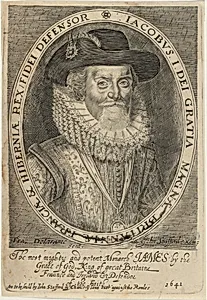
This engraving of James I, created by Francis Delaram in 1641, captures the likeness of England’s first Stuart monarch more than fifteen years after his death. Delaram worked in the flourishing tradition of British printmaking, producing finely detailed portraits that circulated widely among collectors and scholars. The modest plate size—roughly the dimensions of a small book illustration—made the image practical for insertion into volumes or personal albums, allowing viewers far from London to encounter the king’s features. Engraving as a medium was prized in the seventeenth century for its precision and reproducibility. Using a sharp tool called a burin, the artist incised crisp lines into a copper plate, which could then yield hundreds of impressions. Here, the technique renders the textures of lace, fur, and embroidered cloth with remarkable clarity, conveying both royal splendor and the tactile qualities of court dress. Now preserved in the National Gallery of Art’s Rosenwald Collection, the print serves as a quiet reminder of how images helped shape public memory of rulers during a period of political upheaval. Its survival testifies to the enduring appeal of engraved portraiture as both historical record and artistic achievement.
About the Artist
Francis Delaram · 1590–1627
Francis Delaram (c. 1590–1627) was a prolific English engraver active in London during the early Jacobean era, producing several hundred plates that captured the likenesses of monarchs, nobles, and scholars. Flourishing from around 1615, he specialized in line engravings for portraits, title pages, and book illustrations, often working after prominent painters. His output contributed significantly...