
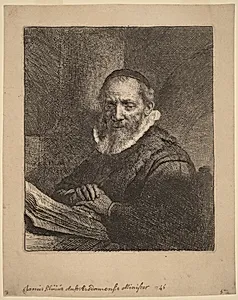
Jan Cornelisz. Sylvius
Medium
etching
Classification
Department
CG-E
Museum
National Gallery of Art, Washington, D.C.
Credit
Rosenwald Collection
Accession Number
1943.3.7093
Rights
Public Domain
Art Historical Context
In 1633, Rembrandt van Rijn, the Dutch Baroque master, created this intimate etching portrait of *Jan Cornelisz. Sylvius*, a Calvinist preacher and scholar from Leiden. At just 27 years old, Rembrandt was already establishing his reputation in the Netherlands during the Dutch Golden Age, a time of cultural flourishing fueled by trade prosperity and religious tolerance. This work captures Sylvius in a thoughtful pose, likely reflecting the personal connections in Rembrandt's early circle—Sylvius was a family acquaintance and influential figure in Leiden's intellectual life. Rembrandt's genius shines through his innovative etching technique, where acid bites into a metal plate to create precise lines and textures. Unlike earlier printmakers, he masterfully layered cross-hatching and drypoint for dramatic light effects and psychological depth, making this print a standout example of his early experimentation. Etchings like this were affordable reproductions, allowing wider access to his artistry beyond paintings. Housed in the National Gallery of Art's Rosenwald Collection, this piece exemplifies Rembrandt's ability to infuse portraits with humanity and spirituality, bridging personal portraiture with the era's Protestant emphasis on inner character. A testament to his enduring printmaking legacy, it invites visitors to appreciate the fine artistry of 17th-century Europe.
About the Artist
Rembrandt van Rijn · 1606–1669
Rembrandt Harmenszoon van Rijn (1606–1669) stands as one of the greatest visual artists in the history of Western art and the most important Dutch painter of the 17th century. Born in Leiden to a prosperous miller's family, Rembrandt transformed painting through his revolutionary use of light and shadow, his psychological depth in portraiture, and his elevation of etching to a fine art. His approx...