
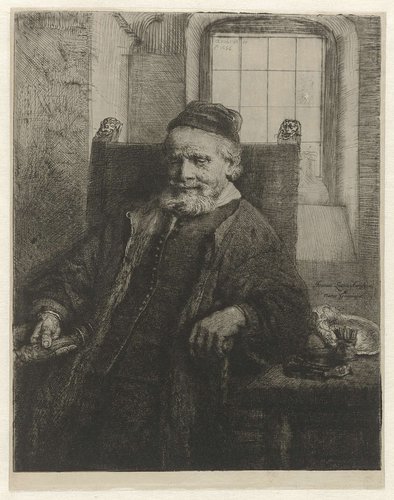
Jan Lutma, goldsmith
Medium
etching
Dimensions
193; 149
Rights
Public Domain
About this artwork
ets, droge naald en burijn, gedrukt met lichte plaattoon op Oosters papier
Art Historical Context
In 1656, Rembrandt vanijn, the Dutch Baroque master renowned for his dramatic light and profound psychological insight, created this intimate etching portrait of Jan Lutma, a celebrated Amsterdam goldsmith. Measuring just 193 x 149 mm, the work captures Lutma's dignified presence amid the opulence of the Dutch Golden, when skilled artisans like him flourished in the prosperous Netherlands. Rembrandt's etching immortalizes a contemporary whose intricate silverwork symbolized the era's wealth and craftsmanship. Rembrandt's technical brilliance shines here through a masterful blend of etching, drypoint, and burin work, printed with a subtle plate tone on luxurious Eastern paper—likely Japanese—for enhanced depth and texture. Drypoint's soft, velvety burr lines convey the goldsmith's textured attire and tools, while the burin's precise incisions add sharp definition, showcasing Rembrandt's innovative printmaking that rivaled his paintings in expressiveness. This portrait not only highlights Rembrandt's versatility during a period of personal financial strain but also celebrates the cultural interplay between art and trade in 17th-century Amsterdam, offering visitors a window into a vibrant world of innovation and artistry.
About the Artist
Rembrandt van Rijn · 1606–1669
Rembrandt Harmenszoon van Rijn (1606–1669) stands as one of the greatest visual artists in the history of Western art and the most important Dutch painter of the 17th century. Born in Leiden to a prosperous miller's family, Rembrandt transformed painting through his revolutionary use of light and shadow, his psychological depth in portraiture, and his elevation of etching to a fine art. His approx...