
Jan van Leyden
Medium
Engraving in black on cream laid paper
Dimensions
Sheet: 32 × 23.2 cm (12 5/8 × 9 3/16 in.)
Classification
engraving
Department
Prints and Drawings
Museum
Art Institute of Chicago
Accession Number
27939
Rights
Public Domain
Art Historical Context
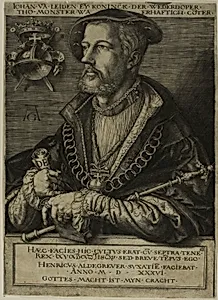
Created in 1536 by the German printmaker Heinrich Aldegrever, this striking engraving captures the likeness of Jan van Leyden, the charismatic leader of the radical Anabaptist movement that briefly seized control of the German city of Münster. Aldegrever, often associated with the “Little Masters” group of engravers who specialized in small-scale, finely detailed prints, worked in the tradition of Albrecht Dürer. His precise line work and careful attention to costume and expression reveal both the sitter’s self-proclaimed royal status and the turbulent religious conflicts of the Reformation era. Executed the same year Jan van Leyden was executed for his role in the Münster Rebellion, the print served as a potent visual record for audiences across Europe. Engravings like this one could be produced in multiples and circulated widely, allowing viewers far from the events to study the features of a figure whose brief “kingdom” had challenged both civic and religious authority. The medium’s crisp black lines on cream paper heighten the dramatic contrast between the sitter’s ornate clothing and the austere background, underscoring the tension between worldly ambition and its consequences. Today the sheet resides in the Art Institute of Chicago’s collection of prints and drawings, where it offers visitors a tangible connection to one of the most dramatic episodes of the sixteenth century. Its survival testifies to the enduring power of printmaking to preserve history and provoke reflection.
About the Artist
Heinrich Aldegrever · 1502–1561
Heinrich Aldegrever, born in 1502 in Paderborn, Westphalia, to parents Herman and Katherine Trippenmeker—a family of clog-makers known by the dialect name Trippenmecker—emerged as a multifaceted artist in the German Renaissance. His early training remains undocumented, though he likely apprenticed in a Soest goldsmith's workshop after relocating there around 1525, where he joined the painters' gui...