
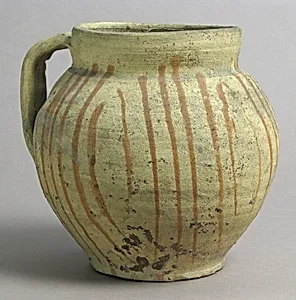
Jar
Unknown Artist
13th–14th century
Medium
Earthenware with slip decoration
Dimensions
Overall: 6 5/8 x 7 1/8 x 6 1/16 in. (16.8 x 18.1 x 15.4 cm)
Classification
Ceramics
Culture
French
Department
Medieval Art
Museum
Metropolitan Museum of Art, New York, NY
Credit
Gift of J. Pierpont Morgan, 1917
Accession Number
17.194.2184
Rights
Public Domain
Art Historical Context
This unassuming yet elegant jar, crafted by an unknown French artisan in the 13th or 14th century, a window into everyday medieval life. Standing just over 6 inches tall and wide, its compact form suggests it was likely used for storing spices, grains, or liquids in a household or workshop. Housed in the Metropolitan Museum of Art's Medieval Art department, it entered the collection as a generous gift from J. Pierpont Morgan 1917, preserving a slice of France's ceramic heritage. Made of earthenware—a sturdy, low-fired clay abundant in medieval Europe—the jar showcases slip decoration, a popular technique of the era. Artisans applied liquid clay (slip) in trails or motifs before firing, creating textured patterns that fused permanently with the surface. This method allowed for affordable, expressive designs without expensive glazes, reflecting the resourcefulness of French potters amid the Gothic period's cultural flowering. As a testament to vernacular art, this jar highlights the unsung role of ceramics in sustaining medieval society, blending utility with subtle artistry. Though anonymous, its survival speaks to enduring craftsmanship from a time of feudal life, chivalric tales, and emerging trade networks.