
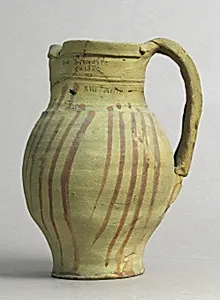
Jar
Unknown Artist
13th century
Medium
Earthenware with slip decoration
Dimensions
Overall: 8 3/16 x 6 1/8 x 5 1/16 in. (20.8 x 15.5 x 12.8 cm)
Classification
Ceramics
Culture
French
Department
Medieval Art
Museum
Metropolitan Museum of Art, New York, NY
Credit
Gift of J. Pierpont Morgan, 1917
Accession Number
17.194.2188
Rights
Public Domain
Art Historical Context
This modest yet evocative 13th-century Frenchware jar, standing just over 8 inches tall, offers a window into everyday medieval life. Crafted by an unknown artisan, its compact form—measuring 8 3/16 x 6 1/8 x 5 1/16 inches—suggests it was likely used for spices, grains, or liquids in a household setting. Housed in the Metropolitan Museum of Art's Medieval Department, it entered the collection as a generous gift from J. Pier Morgan in 1917, highlighting the era's growing appreciation for vernacular crafts. The jar's surface features slip decoration, a technique where liquid clay (slip) is trailed or brushed onto the unfired body to create patterns, often geometric or floral motifs, before a final firing seals the design. Common in medieval Europe, this method allowed potters to add visual interest to functional objects without advanced glazing, reflecting resourcefulness in regional workshops. French ceramics from this period bridged Roman traditions and later Renaissance innovations, emphasizing durability over ornamentation. As a survivor of centuries, this jar embodies the cultural heartbeat of 13th-century France—a time of Gothic cathedrals and feudal societies—reminding us that art thrived not just in grand halls but in humble homes. Its simplicity invites us to ponder the anonymous hands that shaped it.