
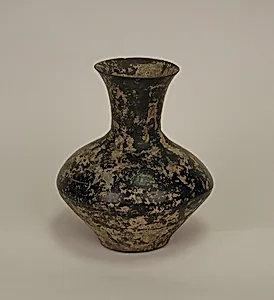
新石器時代大汶口文化 磨光黑陶壺|Jar (Hu)
Unknown Artist
2800–2400 BCE
Medium
Burnished black earthenware
Dimensions
H. 7 3/16 in. (18.3 cm); W. 6 1/16 in. (15.4 cm)
Classification
Ceramics
Culture & Period
China · Neolithic period, late Dawenkou culture
Department
Asian Art
Museum
Metropolitan Museum of Art, New York, NY
Credit
Rogers and Seymour Funds, 1992
Accession Number
1992.297.2
Rights
Public Domain
Art Historical Context
This elegant jar (hu), crafted during the late Neolithic Dawenkou culture (2800–2400 BCE) in ancient China, exemplifies the remarkable pottery skills of one of East Asia's earliest complex societies. Hailing from the Shandong region, the Dawenkou people were innovative farmers and artisans whose communities featured planned burials with grave goods like this vessel, hinting at emerging hierarchies and ritual practices. Standing just over 7 inches tall, its compact, rounded form with a flaring mouth made it ideal for storing grains, liquids, or offerings. The jar's burnished black earthenware medium is a highlight of Neolithic ingenuity. Artisans shaped the clay by hand, then meticulously polished its surface with stones before firing it in a low-oxygen kiln, producing the signature glossy black sheen without glazes—a technique that required precise control and foreshadowed later Chinese ceramic traditions. This labor-intensive process not only ensured durability but also lent the pot a lustrous, almost metallic quality, prized for both utility and symbolism. Today, housed in the Metropolitan Museum of Art's Asian Art department (acquired through the Rogers and Seymour Funds in 1992), this hu offers a tangible link to prehistoric China, revealing how everyday objects evolved into cultural treasures that influenced millennia of ceramic artistry.