
Container in the Form of a Bronze Jar (Hu)
Warring States period, 475–221 BCE
Medium
Earthenware
Dimensions
36 × 21.6 cm (14 × 8 1/2 in.); Diam.: 21.6 cm (8 1/2 in.)
Classification
vase
Department
Arts of Asia
Museum
Art Institute of Chicago
Accession Number
21385
Rights
Public Domain
About this artwork
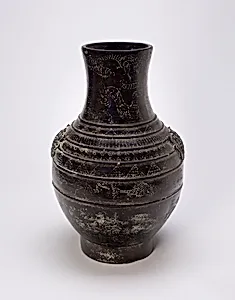
The shape of this container and the monster-mask (taotie) decoration on its sides closely imitate those of bronze vessels. The use of clay rather than the more costly bronze reveals the object’s function as mingqi or “spirit good,” an object that was made specifically for the funerary context. The animal imagery and geometric patterns on the vessel surface, however, are distinctive to objects made of clay. Tigers, fish, and birds—images drawn from land, water, and air—represent early attempts in...
Art Historical Context
This striking earthenware vessel rises in a graceful silhouette, its rounded body swelling from a short foot before tapering into a tall, slightly flared neck. The dark surface, once perhaps burnished to a metallic sheen, now shows subtle wear and tonal variation. Incised lines create rhythmic bands of geometric patterns—triangles, dots, and wavy motifs—while stylized fish swim across the lower register and dragon-like creatures coil along the neck, their forms rendered with economical, confident strokes. Created during China’s Warring States period (475–221 BCE), this container takes the shape of a traditional bronze jar known as a hu. Although made of earthenware rather than costly bronze, it carefully reproduces the proportions and decorative vocabulary of ritual metal vessels of the time. Such works reflect the period’s inventive blending of materials and the enduring importance of elegant, symbolic forms in daily and ceremonial life. Now in the collection of the Art Institute of Chicago, the piece invites us to appreciate how ancient artisans transformed humble clay into objects of quiet sophistication and lasting beauty.
About the Artist
Unknown
The artist designated as "Unknown" in our virtual museum's collection exemplifies a poignant chapter in art history: creators whose identities have faded into obscurity despite the enduring power of their work. With only one known artwork attributed to them in our holdings, this figure represents countless anonymous hands that shaped visual culture across centuries. Museums worldwide, including th...