
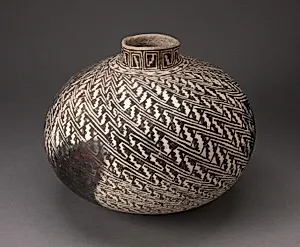
Jar with Interlocking-Stepped Motifs in Diagonal Pattern
950–1400
Medium
Ceramic and pigment
Dimensions
Approx: 20.3 × 27.9 cm (8 × 11 in.)
Classification
earthenware
Department
Arts of the Americas
Museum
Art Institute of Chicago
Accession Number
51144
Rights
Public Domain
Art Historical Context
Nestled in the Art Institute of Chicago's Arts of the Americas collection, this striking *Jar with Interlocking-Stepped Motifs Diagonal Pattern* hails from the Ancestral Pueblo (Anas) people of the American Southwest, dating between 950 and 1400 CE. at approximately 20.3 × 27.9 cm (8 × 11 in.), this earthenware vessel exemplifies the masterful ceramic traditions of these innovative communities, who thrived in regions like present-day Arizona and New Mexico during the Pueblo II and III periods. The jar's surface bursts with bold, interlocking stepped motifs arranged in a dynamic diagonal pattern, painted in black pigment over a buff clay slip. These geometric designs—reminiscent of terraced ladders or architectural steps—are hallmarks of Ancestral Pueblo pottery, possibly evoking sacred kivas, clan symbols, or pathways to the spiritual realm. Crafted through coiling, scraping, and precise firing techniques, such jars served both practical purposes like storage and water carrying, as well as ceremonial roles, often traded across vast networks. This artwork offers a window into a vibrant prehistoric culture that harmonized art with daily life, influencing later Native American traditions. Its enduring geometric elegance reminds us of the Ancestral Pueblo's ingenuity and deep connection to their landscape.