
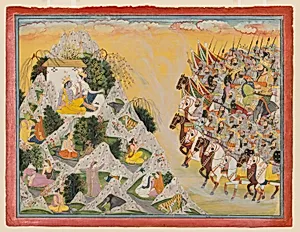
Jarasandha’s army advances toward Krishna and Balarama, folio from a <em>Mahabharata</em>
ca. 1800-1815
Classification
Painting
Department
Smithsonian Collection
Museum
Smithsonian American Art Museum
Credit
Purchase and partial gift from the Catherine and Ralph Benkaim Collection — funds provided by the Friends of the National Museum of Asian Art
Accession Number
S2018.1.17
Rights
Public Domain
Tags
About this artwork
Kangra school
Art Historical Context
This vibrant folio from a *Mahabharata* series captures a tense moment from the ancient Indian epic: Jarasandha’s vast army marching toward Krishna and his brother Balarama. In the story, Jarasandha, the powerful king of Magadha, launches repeated invasions against the Yadavas to avenge his daughters' humiliation. Krishna and Balarama, divine incarnations revered in Hinduism, stand resolute amid the advancing soldiers, symbolizing dharma's triumph over tyranny. Created around 1800–1815, this painting reflects the epic's enduring themes of heroism, duty, and cosmic battle. Attributed to Purkhu, a master of the Kangra school—a pinnacle of Pahari miniature painting from the Himalayan foothills of northern India—this work exemplifies the school's lyrical elegance. Kangra artists, flourishing under princely patronage in the late 18th and early 19th centuries, were renowned for their fine brushwork, luminous colors, and intricate details in depicting landscapes, figures, and emotions. Though the medium is unspecified, such folios typically used opaque watercolors on paper, bringing epic narratives to life in intimate, portable formats for royal libraries and devotees. Housed in the Smithsonian's National Museum of Asian Art through the Catherine and Ralph Benkaim Collection, this piece highlights the Kangra tradition's role in visualizing sacred texts, blending devotional fervor with artistic refinement. It invites viewers to ponder the Mahabharata's moral complexities amid a dynamic battlefield tableau.