
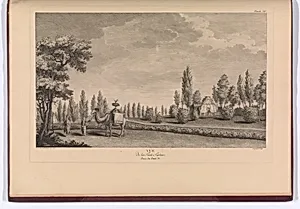
Jardin de Monceau
Medium
Engraving
Dimensions
Overall: 22 7/16 x 16 1/8 x 1 in. (57 x 41 x 2.5 cm)
Classification
Books
Department
Drawings and Prints
Museum
Metropolitan Museum of Art, New York, NY
Credit
Harris Brisbane Dick Fund, 1942
Accession Number
42.142
Rights
Public Domain
Tags
Art Historical Context
Created in 1779, *Jardin de Monceau* is an engraving that captures the enchanting landscape of the Parc Monceau in Paris. This collaborative work by Louis de Carmontelle, Jean Charles Delafosse, and Louis Joseph Masquelier presents a picturesque scene filled with winding paths, lush trees, and elegant figures, including men and even camels—elements that highlight the garden’s playful follies and exotic touches. As a printed work classified among books, the engraving served as both documentation and inspiration, allowing viewers to experience the celebrated garden through detailed reproduction. The medium of engraving was especially significant in the late eighteenth century, enabling the widespread sharing of innovative garden designs during a period when landscape architecture flourished among the French aristocracy. Carmontelle, known for his work on the Duke of Orléans’s estate, brought theatrical flair to these scenes, blending natural beauty with imaginative elements that reflected Enlightenment-era interests in nature, travel, and spectacle. Housed in the Metropolitan Museum’s collection of drawings and prints, this piece offers a charming window into how gardens were celebrated as living works of art.
About the Artist
Louis de Carmontelle|Jean Charles Delafosse|Louis Joseph Masquelier · 1717–1806
**Louis Carrogis Carmontelle** (15 August 1717 – 26 December 1806) was a multifaceted French artist, dramatist, architect, and inventor whose career bridged the worlds of courtly entertainment and innovative visual arts during the Rococo era. Born in Paris to a modest family—his father worked as a bootmaker—he rose through talent and wit from humble origins to serve prominent noble households. He ...