
Jardinière
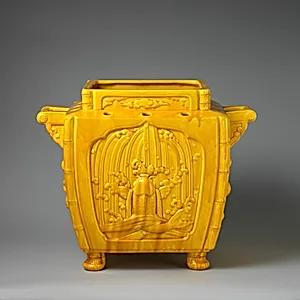
Medium
Glazed pottery (Minton majolica)
Dimensions
Overall: 17 1/2 × 20 1/2 in. (44.5 × 52.1 cm)
Classification
Ceramics-Pottery
Culture
British, Stoke-on-Trent, Staffordshire
Department
European Sculpture and Decorative Arts
Museum
Metropolitan Museum of Art, New York, NY
Credit
Purchase, Friends of European Sculpture and Decorative Arts Gifts, 1995
Accession Number
1995.273
Rights
Public Domain
Tags
Art Historical Context
This vibrant *Jardinière*, created in 1883 by pioneering British designer Christopher Dresser for the renowned Minton pottery firm, exemplifies the exuberance of Victorian-era decorative arts. Produced in Stoke-on-Trent, Staffordshire—the heart of Britain's ceramics industry—this glazed majolica piece measures an impressive 17½ × 20½ inches, designed as an ornate plant stand or flower pot. Minton majolica, inspired by Renaissance Italian maiolica techniques, featured richly colored, lead-glazed earthenware with sculptural forms and naturalistic motifs, making it a staple for Victorian homes and gardens. Dresser, a leader in the Aesthetic Movement, brought a modern sensibility to the form, blending Japanese influences with bold, asymmetrical designs that prioritized beauty and utility. The jardinière's lively decoration—featuring fish and turtles—captures an underwater fantasy, showcasing the medium's technical prowess in achieving glossy, jewel-toned glazes that mimic life-like textures and movement. Such pieces highlighted the era's fascination with nature and exoticism, transforming everyday objects into artistic statements. Acquired by The Metropolitan Museum of Art in 1995 through the Friends of European Sculpture and Decorative Arts, this jardinière reflects the industrial innovation of 19th-century Britain, where designers like Dresser elevated mass-produced ceramics to museum-worthy sculpture. Visitors will appreciate its playful yet sophisticated charm, a window into Victorian opulence.
About the Artist
Christopher Dresser|Minton(s) · 1834–1904
Christopher Dresser (1834–1904) was one of the most innovative and prolific designers of the nineteenth century, widely regarded as a pioneer of industrial design long before that discipline had a name. Born in Glasgow, Scotland, he trained at the Government School of Design in London, where he studied under leading educators committed to improving the quality of British manufactured goods. He wen...