
Jean Baptiste Isabey
1854
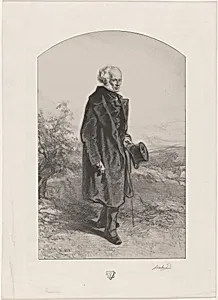
Medium
lithograph on chine collé
Classification
Department
CG-E
Museum
National Gallery of Art, Washington, D.C.
Credit
Gift of James A. Bergquist, Boston, in honor of Shelley R.Langdale
Accession Number
2020.149.18
Rights
Public Domain
Art Historical Context
**Jean Baptiste Isabey** by Paul Gavarni (1854) is a lithograph on chineé, capturing the likeness of the renowned French painter Jean-Baptiste Isabey (1767–1855). Housed in the National Gallery Art's Department of Prints (CG-E), this work was generously gifted by James A. Bergquist Boston in honor of Shelley R. Langdale. Gavarni, a leading 19th-century French lithographer known for his sharp social observations and elegant line work, pays homage to Isabey, a miniaturist celebrated for his intimate portraits of Napoleonic-era figures and European elites. Lithography, perfected in the early 1800s, revolutionized printmaking by allowing artists to draw directly on stone for rich tonal effects and mass reproduction—bridging fine art with wider audiences. Gavarni's mastery shines here, blending precision with expressive flair typical of Second Empire France, where prints like this documented cultural luminaries amid rapid social change. The chine collé technique, gluing the thin lithographic paper to a sturdy support, enhances durability and color depth, preserving the print's delicate nuances. This piece invites visitors to appreciate how 19th-century prints fused portraiture with innovation, reflecting an era's artistic legacy.
About the Artist
Paul Gavarni · 1804–1866
Paul Gavarni, born Sulpice Guillaume Chevalier on January 13, 1804, in Paris to a cooper father from Burgundy and mother Marie-Monique Thiémet—whose brother, painter Guillaume Thiémet, served as his godfather—began his career far from the art world. As a youth, he worked in a machine factory and studied mechanical drawing at the Conservatoire des Arts et Métiers in 1818, followed by evening classe...