
Jean Restout
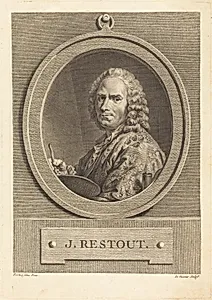
Medium
engraving with etching
Dimensions
plate: 26.5 x 18.5 cm (10 7/16 x 7 5/16 in.) sheet: 29 x 21.3 cm (11 7/16 x 8 3/8 in.)
Classification
Department
CG-E
Museum
National Gallery of Art, Washington, D.C.
Credit
Gift of John O'Brien
Accession Number
1985.44.5
Rights
Public Domain
Art Historical Context
Welcome to the National Gallery of Art, where this elegant 18th-century print, *Jean Restout*, invites us into the world of French artistic circles. Created by engraver Jean Charles Levas after a composition by painter Jean Bernard Restout (2–1768), it dates to between 172 and 1750. Restout, a prominent history painter and member of the Académie Royale de Peinture et de Sculpture, likely depicted his contemporary or relative Jean Restout in this work, capturing the refined portraiture style of the Rococo era with its graceful lines and subtle elegance. The medium—engraving combined with etching—marks a sophisticated printmaking technique of the time. Engraving provided precise, durable lines for intricate details, while etching added fluid, tonal softness through acid-bitten plates, allowing reproductions of paintings to reach a broader audience beyond elite collectors. Measuring 26.5 x 18.5 cm on the plate, this intimate sheet reflects the era's booming print market, which democratized art during France's Enlightenment. Generously gifted by John O'Brien to the museum's Prints department (CG-E), this piece highlights the collaborative spirit of 18th-century art production, bridging painting and printmaking to preserve legacies like Restout's. A testament to technical mastery and cultural exchange, it offers visitors a window into the vibrant Parisian art scene.