
Jeno Kertész
June 18, 1922
Medium
gelatin silver print
Dimensions
image: 3.7 x 5.1 cm (1 7/16 x 2 in.) sheet: 3.9 x 5.3 cm (1 9/16 x 2 1/16 in.)
Classification
Photograph
Department
CPH
Museum
National Gallery of Art, Washington, D.C.
Credit
Gift of The André and Elizabeth Kertész Foundation
Accession Number
2000.170.19
Rights
Public Domain
Art Historical Context
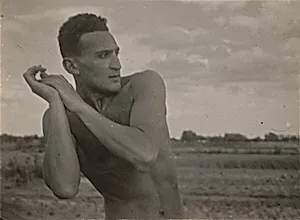
**Jeno Kertész** (June 18, 1922) is an intimate gelatin silver print by André Kertész, the-born photographer whose innovative work bridged pictorialism and modernism. Captured in Budapest just before Kertész's move to Paris in 192, this tiny image—measuring just 3.7 x 5.1 cm—exemplifies his early mastery of everyday poetry. The title likely refers to his brother Jenő, a personal subject that reveals Kertész's affection for capturing quiet, human moments amid interwar Europe's uncertainties. Gelatin silver prints, popular in the 1920s, allowed for sharp tonal contrasts and rich detail on paper coated with light-sensitive silver halides, making them ideal for Kertész's crisp compositions. Though modest in scale, this photograph foreshadows his signature style: geometric precision, natural light, and emotional depth that influenced street photography pioneers like Henri Cartier-Bresson. Now housed in the National Gallery of Art's photography department, thanks to a gift from The André and Elizabeth Kertész Foundation, it invites visitors to appreciate how Kertész transformed the ordinary into the timeless. A gem for fans of modernist photography, it reminds us that great art often begins at home.
About the Artist
André Kertész · 1894–1985
André Kertész, born Andor Kertész on July 2, 1894, in Budapest, Hungary, to a middle-class Jewish family, initially pursued a conventional path as a clerk at the Budapest Stock Exchange after graduating from the Academy of Commerce in 1912. Self-taught in photography after purchasing his first camera that year, he captured his early poetic visions of Hungarian landscapes and peasant life, includin...