
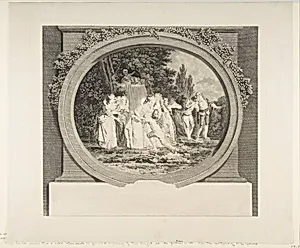
Jeu de Societe dans un Parc
Medium
Etching
Dimensions
sheet: 13 3/8 x 15 7/8 in. (34 x 40.3 cm) image: 10 11/16 x 12 1/8 in. (27.1 x 30.8 cm)
Classification
Prints
Department
Drawings and Prints
Museum
Metropolitan Museum of Art, New York, NY
Credit
The Elisha Whittelsey Collection, The Elisha Whittelsey Fund, 1959
Accession Number
59.599.37
Rights
Public Domain
Tags
Art Historical Context
Jean Honoré Fragonard's *Jeu de Société dans un Parc* (Society Game in a Park,.d.) captures the playful essence of 18th-century leisure. This etching depicts boys, girls, and women engaged in a lighthearted game amid a lush park setting, evoking the Rococo spirit of joy, flirtation, and aristocratic pastimes. Fragonard, a master of the Roc movement, delighted in such scenes of gallantry and outdoor revelry, often drawing from the opulent world of Versailles-era France, where social gatherings blended elegance with whimsy. As an etching, the work showcases Fragonard's skill in intaglio printmaking, where acid etches intricate lines into a metal plate for rich, tonal depth. Measuring about 10½ by 12 inches in its image area, this print allowed wider dissemination of his delicate, fluid style—characterized by swirling foliage, expressive figures, and a sense of spontaneous movement—beyond elite patrons to a broader audience. Prints like this were prized collectibles, bridging painting and graphic art. Housed in the Metropolitan Museum of Art's Drawings and Prints department (The Elisha Whittelsey Collection, 1959), it reflects Rococo's cultural zenith before the Revolution's austerity. Visitors will appreciate how Fragonard's etching immortalizes a fleeting moment of carefree sociability, inviting us to linger in its verdant charm.
About the Artist
Jean Honoré Fragonard · 1732–1806
Jean-Honoré Fragonard (1732-1806) was a French painter and printmaker whose late Rococo manner was distinguished by remarkable facility, exuberance, and hedonism. Born in Grasse, he moved to Paris where he trained under Jean-Baptiste Chardin and François Boucher, winning the prestigious Prix de Rome in 1752. After studying in Italy alongside Hubert Robert, Fragonard returned to Paris in 1761 to fi...