
Jewelry
Unknown Artist
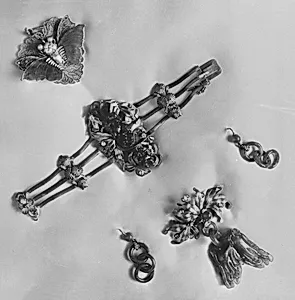
Medium
Jadeite, emerald green
Dimensions
Pendant: H. 3 3/4 in. (9.5 cm) Pair of earrings: H. 2 1/4 in. (5.7 cm) Bracelet: H. 3 in. (7.6 cm); W. 3 in. (7.6 cm)
Classification
Jade
Culture & Period
China · Qing dynasty (1644–1911), Qianlong period (1736–95)
Department
Asian Art
Museum
Metropolitan Museum of Art, New York, NY
Credit
Gift of Heber R. Bishop, 1902
Accession Number
02.18.733a–d
Rights
Public Domain
Art Historical Context
This exquisite set of jadeite jewelry, featuring a pendant, pair of earrings, and bracelet hails from China's Qing dynasty during the Qianlong period (6–95), a golden era of imperial patronage and artistic refinement. Crafted from rare emerald-green jadeite—a vivid hue symbolizing prosperity and purity in Chinese culture—these pieces exemplify the era's mastery of jade carving. The Qianlong emperor himself was a fervent collector of jade, commissioning works that blended technical precision with symbolic elegance, often evoking natural motifs like flowers or mythical creatures, though specific designs here remain unrecorded. Jade held profound cultural importance in imperial China, reserved for the elite as adornments that conveyed status and harmony with nature. The meticulous polishing of jadeite, prized for its translucency and toughness, allowed artisans to achieve luminous surfaces and intricate forms without metal settings, highlighting the stone's innate beauty. Measuring a pendant at 3¾ inches high, earrings at 2¼ inches, and a bracelet at 3 inches square, this suite was likely worn for ceremonial occasions. A generous gift to the Metropolitan Museum of Art from Heber R. Bishop in 1902, these jewels offer a glimpse into Qing opulence, inviting visitors to marvel at the enduring allure of Chinese jade craftsmanship.