
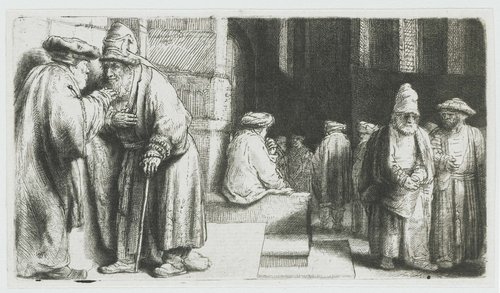
Jews in the synagogue
Medium
etching
Dimensions
129; 72
Rights
Public Domain
About this artwork
ets en droge naald
Art Historical Context
In 1648, Rembrandt van Rijn, the masterful Dutch Baroque artist of the Golden Age created *Jews in the Syn*, a intimate etching measuring just 72 mm high by 129 mm wide. This small-scale print captures a poignant moment of communal prayer among Jewish figures in an Amsterdam synagogue, reflecting Rembrandt's fascination with the Sephardic Jewish community that had recently resettled in the Netherlands expulsions from Spain and Portugal Living near the Jewish quarter, Rembrandt portrayed these subjects with empathy and dignity, a rarity in an era of religious tensions. The work's medium—etching combined with drypoint ("ets en droge naald" in Dutch)—showcases Rembrandt's innovative printmaking genius. Etching allowed precise lines through acid-bitten plates, while drypoint's direct needle scratches produced velvety burrs for rich, tonal depth, mimicking his oil paintings' dramatic chiaroscuro. This technique enabled subtle light filtering through imagined windows, illuminating devout faces in shadow, evoking spirituality and introspection. As one of Rembrandt's evocative genre scenes, *Jews in the Synagogue* highlights his technical prowess and cultural curiosity, offering visitors a window into 17th-century Amsterdam's diverse life and the artist's humanistic vision.
About the Artist
Rembrandt van Rijn · 1606–1669
Rembrandt Harmenszoon van Rijn (1606–1669) stands as one of the greatest visual artists in the history of Western art and the most important Dutch painter of the 17th century. Born in Leiden to a prosperous miller's family, Rembrandt transformed painting through his revolutionary use of light and shadow, his psychological depth in portraiture, and his elevation of etching to a fine art. His approx...