
Job and his Daughters
1825–26
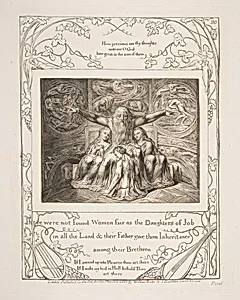
Medium
Engraving
Dimensions
plate: 8 7/16 x 6 5/8 in. (21.4 x 16.8 cm) sheet: 16 3/8 x 10 7/8 in. (41.6 x 27.6 cm)
Classification
Prints
Department
Drawings and Prints
Museum
Metropolitan Museum of Art, New York, NY
Credit
Gift of Edward Bement, 1917
Accession Number
17.17.1–20
Rights
Public Domain
Tags
Art Historical Context
William Blake's *Job and his Daughters*1825–26) is a poignant engraving from his monumental series *Illustrations of the Book of Job*, one of the artist's final masterpieces completed in his later years. Depicting a biblical scene from the Book of Job—where the patriarch, after enduring profound suffering and loss, is blessed with new daughters symbolizing restoration and divine mercy—Blake captures a moment of tender familial reunion. The tags highlighting "Girls" and "Job" underscore the focus on these youthful figures, radiant amid their father's quiet dignity, reflecting themes of faith, resilience, and redemption central to Blake's visionary worldview. As a master of Romantic printmaking, Blake hand-engraved all 22 plates in the series using a meticulous technique blending relief etching and fine-line engraving on copper plates, allowing him to control every detail from composition to printing. This medium was revolutionary for its time, enabling Blake to infuse his mystical imagination into affordable, reproducible art that rivaled painting in expressiveness. Measuring a modest plate size of 8 7/16 x 6 5/8 inches, the work exemplifies his intricate line work, where swirling forms and ethereal glows evoke spiritual ecstasy. Housed in the Metropolitan Museum of Art's Drawings and Prints department (gift of Edward Bement, 1917), this engraving invites visitors to ponder Blake's lifelong obsession with Job's trials as a metaphor for the artist's own struggles. It's a testament to how 19th-century visionary art bridged biblical narrative with personal revelation, offering timeless solace.
About the Artist
William Blake|William Blake · 1757–1827
William Blake (1757–1827) stands as one of the most visionary and unconventional artists in British history, a poet-painter-printmaker whose mystical imagination and radical vision profoundly shaped the Romantic movement. Born in London's Soho district, Blake experienced visions from childhood—claiming to see angels in trees at age eight—and these spiritual encounters would guide his art throughou...