
Job
1911
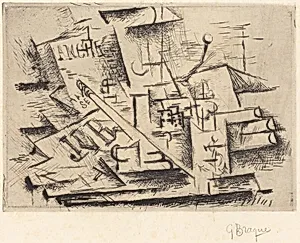
Medium
etching in black on wove paper
Dimensions
plate: 14.5 × 20 cm (5 11/16 × 7 7/8 in.)
Classification
Department
CG-W
Museum
National Gallery of Art, Washington, D.C.
Credit
Rosenwald Collection
Accession Number
1964.8.389
Rights
Public Domain
Art Historical Context
Georges Braque's *Job*, created in 1911, is a striking etching in black on wove paper, measuring a intimate plate size of 14.5 × 20 cm. Housed in the National Gallery of Art's Rosenwald Collection, this print exemplifies Braque's mastery during a pivotal moment in modern art. As a co-founder of Cubism alongside Pablo Picasso, Braque was immersed in Analytic Cubism by 1911, fragmenting forms and multiple viewpoints to challenge traditional perspective. The etching technique—incising lines into a metal plate with acid for precise, expressive marks—allowed Braque to explore Cubist geometry with fine control. Wove paper, smooth and uniform, enhances the crispness of the black ink, making this modest-scale work ideal for close contemplation. Prints like this democratized avant-garde art, bridging elite painting with broader audiences. While the title evokes the biblical figure of Job, enduring suffering with faith, Braque's Cubist lens likely reinterprets such themes through abstracted planes and interlocking shapes. A gem of the CG-W Department, it invites visitors to ponder resilience amid artistic revolution.
About the Artist
Georges Braque · 1882–1963
Georges Braque (1882–1963) was a French painter, collagist, and sculptor who, together with Pablo Picasso, invented Cubism — one of the most revolutionary developments in the history of Western art. Born in Argenteuil and raised in Le Havre, he initially trained as a house painter and decorator before studying fine art at the Académie Humbert and the École des Beaux-Arts in Paris. Braque's early ...