
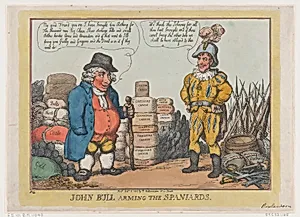
John Bull Arming The Spaniards
October 3, 1808
Medium
Hand-colored etching
Dimensions
Sheet: 10 11/16 × 14 7/8 in. (27.1 × 37.8 cm) Plate: 10 3/16 × 13 9/16 in. (25.8 × 34.4 cm)
Classification
Prints
Department
Drawings and Prints
Museum
Metropolitan Museum of Art, New York, NY
Credit
The Elisha Whittelsey Collection, The Elisha Whittelsey Fund, 1959
Accession Number
59.533.1185
Rights
Public Domain
Tags
Art Historical Context
This hand-colored etching, published on October 3, 1808, by Rudolph Ackermann in London and likely designed by the celebrated caricaturist Thomas Rowlandson, captures a moment of sharp political satire during the Napoleonic Wars. Titled *John Bull Arming The Spaniards*, the print uses the familiar figure of John—Britain’s stout, no-nonsense national personification—to depict British support for Spanish resistance against French occupation. At the center stands Joseph Bonaparte, Napoleon’s brother and recently installed ruler of Spain, whose presence underscores the contested legitimacy of French rule on the Iberian Peninsula. Created as a hand-colored etching, the work belongs to the vibrant tradition of Georgian political prints that combined bold outlines with vivid watercolor washes for wide circulation. Such prints were affordable, portable, and highly effective at shaping public opinion, allowing London audiences to follow the unfolding Peninsular War from afar. Rowlandson’s lively draftsmanship and Ackermann’s publishing network made these images both entertaining and influential. Today the sheet resides in the Metropolitan Museum of Art’s Department of Drawings and Prints, part of the Elisha Whittelsey Collection. It offers modern viewers a lively window into how early-nineteenth-century Britons used humor and symbolism to comment on international conflict and shifting alliances.
About the Artist
Rudolph Ackermann, London|Joseph Bonaparte|Thomas Rowlandson · 1794–1832
**Rudolph Ackermann (1764–1834)** was a pivotal Anglo-German publisher, printseller, and entrepreneur whose London-based business shaped Regency-era visual culture through innovative printmaking and illustrated publications. Born in Stollberg, Saxony, he trained as a saddler and coach-builder before moving to London around 1787. He initially worked in carriage design and related trades, later esta...