
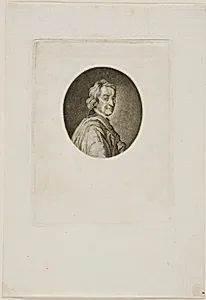
John Dryden
Medium
Engraving on paper
Dimensions
Image: 3.9 × 3.4 cm (1 9/16 × 1 3/8 in.); Plate: 8 × 6.1 cm (3 3/16 × 2 7/16 in.); Sheet: 12.6 × 8.7 cm (5 × 3 7/16 in.)
Classification
aquatint
Department
Prints and Drawings
Museum
Art Institute of Chicago
Accession Number
53651
Rights
Public Domain
Art Historical Context
This delicate aquatint engraving, titled *John Dryden*, captures the likeness of the renowned 17th-century English poet playwright, and literary critic John Dryden (1631–1700), known for his satirical verse, heroic couplets, and works like *Absalom and Achitophel*. Created by French engraver Jean-Baptiste de Group (undated), it exemplifies the intimate portraiture popular in printmaking traditions, allowing widespread dissemination of celebrated figures' images during the Enlightenment era. Aquatint, the classification here, is an intaglio technique invented in the late 18th century that uses resin-dusted plates and acid to produce soft, painterly tones mimicking watercolor washes—ideal for nuanced shading in small-scale portraits like this one (image just 3.9 × 3.4 cm). Grateloup's precise rendering highlights the medium's versatility, bridging painting and print for affordable art collecting among scholars and enthusiasts. Housed in the Art Institute of Chicago's Prints and Drawings Department, this diminutive gem (sheet: 12.6 × 8.7 cm) invites close inspection, revealing how engravings preserved literary legacies, making icons like Dryden accessible to generations beyond his time. A testament to print's cultural role!
About the Artist
Jean-Baptiste de Grateloup · 1735–1817
Jean-Baptiste de Grateloup (1735–1817) was a French engraver and miniature painter whose long career spanned the final decades of the ancien régime and the upheavals of the Revolutionary and Napoleonic eras. Born in the Landes region of southwestern France, he established himself in Paris as a professional printmaker working across a range of portrait and reproductive subjects. Grateloup's practi...