
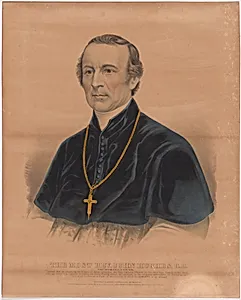
John Joseph Hughes
Medium
Classification
Department
Smithsonian Collection
Museum
Smithsonian American Art Museum
Credit
National Portrait Gallery, Smithsonian Institution; gift of Fred W. Hicks, III
Accession Number
NPG.89.64
Rights
Public Domain
Tags
Art Historical Context
This lithographic portrait, titled *John Joseph Hughes* and produced by the renowned Currier & Ives Lithography in 1864, the likeness of the pioneering Archbishop of New York. John Joseph Hughes (17971864), the first archbishop in the city, rose from humble Irish immigrant roots to become a towering figure in 19th-century American Catholicism. Amid rising anti-Catholic sentiment, he championed education—founding colleges and schools—and defended Irish communities, solidifying the Church's foothold in a Protestant-dominated nation. Created in the year of his death, this print likely served as a tribute, reflecting his enduring legacy during the Civil War era. Currier & Ives, active from 1857 to 1907, revolutionized American printmaking with their affordable, hand-colored lithographs. Masters of the technique, they layered vibrant colors over detailed stone-drawn images, producing over 7,500 scenes of everyday life, landscapes, and notable figures. This medium democratized art, making portraits like Hughes's accessible to middle-class homes and institutions. Housed in the Smithsonian American Art Museum's National Portrait Gallery, this work highlights the intersection of faith, immigration, and visual culture in antebellum America. It reminds visitors of Hughes's role in shaping a pluralistic society, preserved through a gift from Fred W. Hicks, III.