
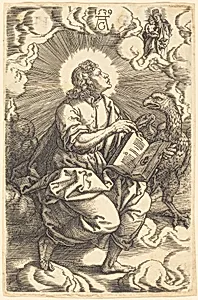
John
Medium
etching
Classification
Department
CG-E
Museum
National Gallery of Art, Washington, D.C.
Credit
Rosenwald Collection
Accession Number
1943.3.242
Rights
Public Domain
Art Historical Context
Heinrich Aldegrever's *John* (1539) is a exquisite etching from the Northern Renaissance, housed in the National Gallery of Art's Rosenwald Collection. during a time of religious upheaval in Europe—the eve of the Protestant Reformation—this print exemplifies the meticulous craftsmanship of German printmakers. Aldegrever, a goldsmith-turned-engraver from Soest (c. 1502–1561), belonged to the "Little Masters artists renowned for their virtuosic small-scale works that rivaled the grandeur of larger paintings. As an etching, *John* showcases a technique where acid etches intricate lines into a metal plate, allowing for fluid, expressive details far beyond woodcuts. Aldegrever's precise linework captures the subject's solemn presence—likely a saintly figure, given the era's focus on devotional imagery—making it ideal for personal piety or scholarly study. Prints like this democratized art, spreading Renaissance humanism and biblical narratives across households. This piece highlights Aldegrever's fusion of Gothic detail with emerging Italianate influences, bridging medieval traditions and modern innovation. A testament to 16th-century technical prowess, it invites visitors to appreciate how humble etchings shaped cultural devotion.
About the Artist
Heinrich Aldegrever · 1502–1561
Heinrich Aldegrever, born in 1502 in Paderborn, Westphalia, to parents Herman and Katherine Trippenmeker—a family of clog-makers known by the dialect name Trippenmecker—emerged as a multifaceted artist in the German Renaissance. His early training remains undocumented, though he likely apprenticed in a Soest goldsmith's workshop after relocating there around 1525, where he joined the painters' gui...