
Medium
Classification
Department
Smithsonian Collection
Museum
Smithsonian American Art Museum
Credit
National Portrait Gallery, Smithsonian Institution; gift of Mr. and Mrs. Paul Mellon
Accession Number
S/NPG.74.39.1.21
Rights
Public Domain
Tags
Art Historical Context
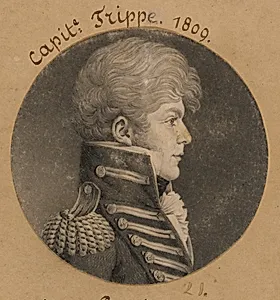
This elegant 1809 print by Charles Balthazar Julienévret de Saint-Mmin captures the poised profile of John Trippe an American officer distinguished by his epaulet—a shoulder ornament symbolizing military rank. Saint-Mémin, a-born artist who fled the Revolution and settled in the United States pioneered a distinctive portrait style using the physiognotrace, a mechanical device that traced subjects' silhouettes with remarkable accuracy before engraving them onto copper plates. This technique produced cameo-like images that blended neoclassical precision with democratic accessibility. Created during a formative era in American history, just before the War of 1812, the portrait reflects the growing national pride in military figures amid tensions with Britain and ongoing conflicts like the Barbary Wars. Trippe, depicted in uniform, embodies the era's valorous officer class. As a print rather than a unique painting, it allowed for multiple impressions, making elite likenesses available to a broader public and underscoring the medium's role in shaping public memory. Housed in the Smithsonian American Art Museum's National Portrait Gallery through a gift from Mr. and Mrs. Paul Mellon, this work highlights Saint-Mémin's influence on early American portraiture, bridging European refinement with New World identity.