
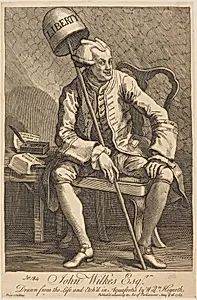
John Wilkes Esq.
1763
Medium
etching
Dimensions
sheet: 35.1 × 23 cm (13 13/16 × 9 1/16 in.) mount: 62.7 × 46.7 cm (24 11/16 × 18 3/8 in.)
Classification
Department
CG-E
Museum
National Gallery of Art, Washington, D.C.
Credit
Rosenwald Collection
Accession Number
1944.5.100
Rights
Public Domain
Art Historical Context
William Hogarth's etching *John Wilkes Esq.*, created in 1763, offers a sharp satirical portrait of the fiery British politician and radical reformer John Wilkes. Hogarth, a pioneering figure in 18th-century art, was renowned for his moralistic and politically charged prints that skewered society's vices and power players. This work, produced on a compact sheet measuring 35.1 × 23 cm, captures the tense atmosphere of mid-Georgian Britain, where Wilkes's outspoken journalism—particularly his inflammatory *North Briton No. 45*—ignited debates on press freedom and government corruption. As an etching, a printmaking technique where acid etches intricate lines into a metal plate, the piece showcases Hogarth's mastery of expressive detail and caricature. Housed in the National Gallery of Art's Rosenwald Collection (Department CG-E), its modest scale belies its cultural punch: it reflects the era's explosive political satire, with Hogarth personally clashing with Wilkes after the latter mocked one of his paintings. This print stands as a vivid artifact of Enlightenment-era dissent. Today, it reminds us how art fueled public discourse, blending artistry with activism in ways that still resonate. (198 words)
About the Artist
William Hogarth · 1697–1764
William Hogarth (1697-1764) was an English painter, printmaker, and pictorial satirist who became the first great English-born artist to attract admiration abroad. Born into poverty in London, the son of a failed schoolmaster who was imprisoned for debt, Hogarth's early experiences with the harsh realities of 18th-century urban life profoundly shaped his artistic vision. After apprenticing with si...