
Joint Stool
1680–1710
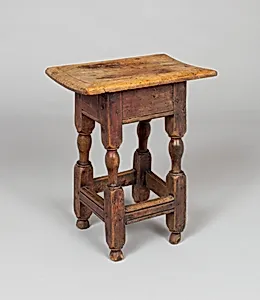
Medium
Maple and pine
Dimensions
48.2 × 38.7 × 24.8 cm (19 × 15 1/4 × 9 3/4 in.)
Classification
seating
Department
Arts of the Americas
Museum
Art Institute of Chicago
Accession Number
104085
Rights
Public Domain
Art Historical Context
This unassuming yet elegantly crafted **Joint Stool**, dating from 1680–1710, exemplifies the practical artistry of colonial American furniture makers in the Arts of the Americas Standing at 48.2 × 38.7 × 24.8 cm, it was designed for everyday use—perfect for dining, workshops, or gatherings in early New England homes. Made by an unknown artisan from sturdy maple and pine, its compact form reflects the resourcefulness of settlers relying on local hardwoods. The stool's name highlights its defining feature: masterful **joinery techniques**, where mortise-and-tenon joints interlock the legs, stretchers, and seat without nails or glue, ensuring remarkable durability. This "knock-down" construction allowed for easy transport across the Atlantic or within growing colonies, showcasing the skill of joiners who elevated utility to art. As a humble survivor of domestic life, this piece offers a window into 17th- and early 18th-century American culture—where functionality met fine craftsmanship. Now housed at the Art Institute of Chicago, it reminds us how ordinary objects embodied the resilience and ingenuity of everyday people.