
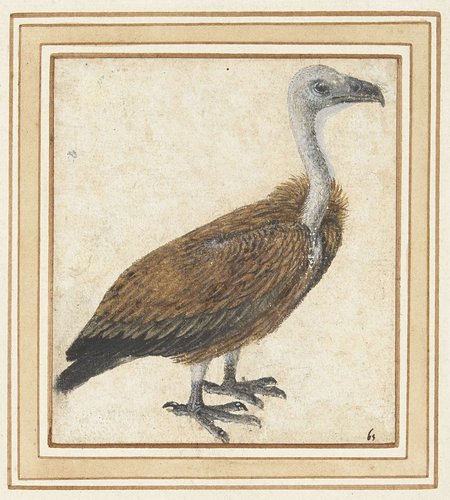
Jonge vale gier (Gyps fulvus)
1500 - 1599
Medium
brush
Dimensions
115; 129
Rights
Public Domain
About this artwork
height 129 mm x width 115 mm
Art Historical Context
Nestled in the annals of Renaissance natural history, *Jonge vale gier (Gyps fulvus)* captures the keen gaze of a young griffon vulture, a majestic bird of prey native to Europe and the Mediterranean. Created anonymously between 1500 and 1599, this intimate brush drawing measures just 129 mm high by 115 mm wide—small enough to fit in the palm of your hand. The medium of brush suggests a delicate application of ink or watercolor, allowing for fluid lines and subtle shading that bring the bird's textured feathers and piercing expression to life. During the 16th century, Europe buzzed with a growing fascination for the natural world, fueled by exploration and early scientific inquiry. Anonymous artists like this one contributed to a burgeoning tradition of naturalistic studies, often found in manuscripts, sketchbooks, or collector's albums. These works bridged art and observation, predating formal ornithological illustrations by figures like Audubon centuries later. The griffon vulture, with its scavenging role in ecosystems, symbolized resilience and the wild in medieval and Renaissance lore. This unassuming gem highlights the era's shift toward empirical realism, where every feather stroke served both aesthetic beauty and budding knowledge. Though its creator remains unknown, it invites us to marvel at nature's intricate details through the lens of a bygone age.
About the Artist
anonymous
In the vast tapestry of art history, "Anonymous" stands not as a singular individual but as a collective designation for countless unidentified creators whose works have endured across millennia. These artists, spanning prehistoric cave painters to medieval illuminators and folk craftsmen, produced the foundational layers of human visual culture. Prior to the Renaissance, when individual fame emer...