
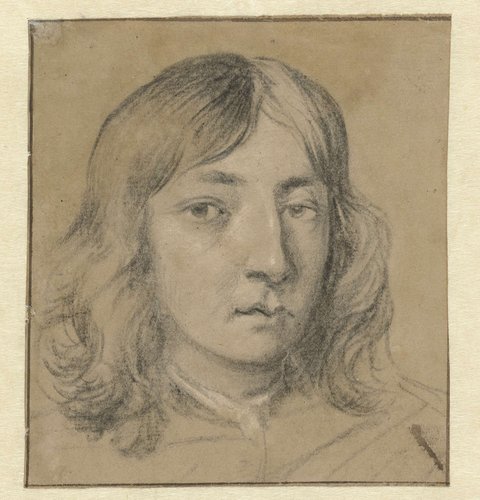
Jongenskop met lang haar
1600 - 1699
Medium
paper
Dimensions
94; 104
Rights
Public Domain
About this artwork
zwart en wit krijt op lichtbruin papier
Art Historical Context
**Jongenskop met haar (Boy's Head with Long)** This delicate 17th-century drawing created anonymously between 1600 and 1699, captures the tender portrait of a young boy with flowing long hair. Rendered in black and white chalk on brown paper, it measures a modest 104 mm high by 94 mm wide—perfect for an intimate study or sketchbook page. The title, in Dutch, hints at its likely origin in the Netherlands during the Golden Age, time when artists excelled in preparatory drawings that explored human expression and form. The technique of black and white chalk on toned paper was a hallmark of Dutch draughtsmanship, allowing artists to achieve dramatic chiaroscuro effects. The light brown ground serves as a mid-tone, enabling the white chalk to highlight luminous areas like the boy's face and hair, while black chalk deepens shadows for a three-dimensional illusion. This method, popularized by masters like Rembrandt, was ideal for quick yet expressive studies, often used in workshops to train apprentices or refine compositions for paintings. Though anonymous, this work reflects the era's fascination with childhood innocence and realistic portraiture, evoking the everyday beauty amid Holland's prosperous cultural boom. A charming glimpse into 17th-century life, it invites visitors to appreciate the subtlety of chalk's texture and the anonymous artist's keen observation.
About the Artist
anonymous
In the vast tapestry of art history, "Anonymous" stands not as a singular individual but as a collective designation for countless unidentified creators whose works have endured across millennia. These artists, spanning prehistoric cave painters to medieval illuminators and folk craftsmen, produced the foundational layers of human visual culture. Prior to the Renaissance, when individual fame emer...