
Joseph Donaldson
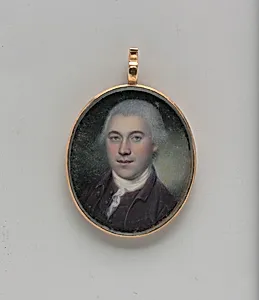
Medium
Watercolor on ivory
Dimensions
1 3/8 x 1 1/8 in. (3.4 x 2.8 cm)
Classification
Painting, miniature
Culture
American
Department
The American Wing
Museum
Metropolitan Museum of Art, New York, NY
Credit
Gift of Gloria Manney, 2006
Accession Number
2006.235.124
Rights
Public Domain
Tags
Art Historical Context
In 1776, the very year the United States declared its independence, Charles Willson Peale the likeness of Joseph Donaldson in this watercolor miniature on ivory. Peale, a prominent American portraitist and Founding Father associate who painted George Washington and other revolutionaries, excelled in these tiny gems—measuring just 1⅜ × 1⅛ inches. Created amid the fervor of the Revolutionary, the portrait reflects the era's demand for personal, portable keepsakes that could be worn as jewelry or carried close to the heart. Watercolor on ivory was a prized 18th-century technique for miniatures, allowing Peale to achieve luminous transparency and fine detail on the smooth, durable surface. These works were not mere trinkets but symbols of status and affection, often exchanged among family or sweethearts. Housed in The Metropolitan Museum of Art's American Wing, this piece highlights early American artistry's blend of European tradition and emerging national identity. Joseph Donaldson's serene gaze invites us to ponder everyday lives during a pivotal moment in history, reminding visitors of the human stories behind the grand events. A gift to the Met in 2006, it showcases Peale's skill in distilling character into intimate scale.
About the Artist
Charles Willson Peale · 1741–1827
Charles Willson Peale (1741–1827) was an American painter, museum founder, naturalist, and inventor who became the most important American portraitist of the Revolutionary era and a central figure in the cultural life of the young republic. Born in Queen Anne's County, Maryland, he initially trained as a saddler before turning to painting, studying briefly with John Singleton Copley in Boston and ...