
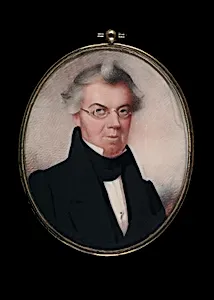
Judge Thomas Ewing
ca. 1840
Medium
Painting-Miniature
Classification
Painting-Miniature
Department
Smithsonian Collection
Museum
Smithsonian American Art Museum
Credit
Smithsonian American Art Museum, Gift of Alexander Vernon Wasson
Accession Number
1976.31
Rights
Public Domain
Tags
About this artwork
Judge Thomas Ewing, born in West Virginia in 1789, began his career as a schoolteacher in Ohio. He went on to practice law and in 1830 was elected to the U.S. Senate. This portrait shows Ewing at around fifty-five years old, about the time he became secretary of the treasury for President Tyler.
Art Historical Context
This exquisite miniature portrait, *Judge Thomas Ewing*, painted by Daniel Dickinson around 1840, captures the likeness of a pivotal figure in early American politics. Depicting Ewing as a bust-length subject at about age 55, the work exemplifies the intimate scale and precision of 19th-century miniature painting typically executed on ivory with fine brushes to create lifelike details in a portable format. These small-scale gems were cherished as personal mementos, often worn as jewelry or kept in cases, reflecting the era's emphasis on family legacy and individual achievement. Thomas Ewing, born in 1789 in what is now West Virginia, rose from humble beginnings as a schoolteacher in Ohio to a prominent lawyer and statesman. Elected to the U.S. Senate in 1830, he later served as Secretary of the Treasury under President John Tyler, navigating the financial turbulence of the young republic. Created at this career pinnacle, the portrait symbolizes Ewing's embodiment of the self-made American success story amid the nation's expansion. Housed in the Smithsonian American Art Museum through a generous gift, this piece highlights Dickinson's skill in the Federalist tradition of portraiture, blending realism with subtle dignity to honor public servants. A window into antebellum elite culture, it invites visitors to ponder the personal faces behind history's grand events.