
Judith
1860s
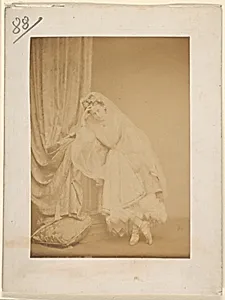
Medium
Albumen silver print from glass negative
Classification
Photographs
Department
Photographs
Museum
Metropolitan Museum of Art, New York, NY
Credit
David Hunter McAlpin Fund, 1975
Accession Number
1975.548.88
Rights
Public Domain
Tags
Art Historical Context
In the 1860s, French photographer Pierre-Louis Pierson *Judith* as an albumen silver print a glass negative, a technique that defined mid-19th-century photography. Albumen prints, made by coating paper with egg whites mixed with light-sensitive silver salts, produced richly toned images with exceptional detail and clarity—ideal for intimate portraits. This medium revolutionized visual culture, making high-quality photographs affordable and widespread during France's Second Empire, a era of opulent fashion and theatrical self-presentation. *Judith* showcases Pierson's expertise in portraiture, likely depicting a woman embodying the biblical heroine known for her daring slaying of the Assyrian general Holofernes. As a society photographer linked to elite circles, Pierson specialized in flattering, dramatic compositions that blurred the line between photography and painting. The work's classification as a portrait of a woman highlights photography's rising role in capturing femininity, identity, and costume, reflecting cultural fascinations with history and myth. Housed in the Metropolitan Museum of Art's Photographs Department (David Hunter McAlpin Fund, 1975), this piece exemplifies how 19th-century innovators like Pierson elevated photography from mere documentation to artistic expression, inviting viewers to ponder the sitter's poised strength and the era's blend of glamour and narrative power.
About the Artist
Pierre-Louis Pierson · 1822–1913
Pierre-Louis Pierson (1822–1913) was a pioneering French portrait photographer whose career spanned the formative years of the medium. Born on December 13, 1822, in Hinckange in the Moselle department, Pierson developed an early fascination with photography during the 1840s, as the daguerreotype was still in its infancy. His early life and formal training remain sparsely documented, but by 1844, h...