
Judith and Her Servant
1520–30
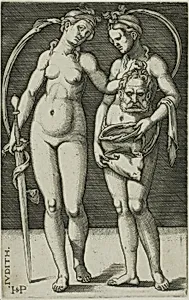
Medium
Engraving in black on ivory laid paper
Dimensions
Image/plate: 10.7 × 6.8 cm (4 1/4 × 2 11/16 in.); Sheet: 19 × 12.7 cm (7 1/2 × 5 in.)
Classification
engraving
Department
Prints and Drawings
Museum
Art Institute of Chicago
Accession Number
77428
Rights
Public Domain
Art Historical Context
In the early 16th century, artist Hans Sebald Beham crafted this exquisite engraving *Judith and Her Servant* around 1520–30, capturing a dramatic biblical moment from the Book of Judith. Here, the heroic widow Judith and her maidserv flee with the severed head of Assyrian general Holofer, symbolizing virtue's triumph over tyranny—a Renaissance theme blending faith, courage, and moral allegory. Beham, a Nuremberg native and one of the "Little Masters," excelled in such intimate scales, rendering the image just 10.7 × 6.8 cm on fine ivory laid paper. As an engraving, the work showcases Beham's mastery of the burin technique, incising fine lines into a copper plate to produce sharp, detailed blacks that convey texture, shadow, and subtle emotion. This printmaking method revolutionized art dissemination during the Northern Renaissance, allowing affordable multiples for collectors and homes amid the Protestant Reformation's cultural shifts. Housed in the Art Institute of Chicago's Prints and Drawings Department, this small gem invites close viewing, revealing Beham's intricate patterns in drapery and landscape. It exemplifies how engravings bridged elite painting and everyday devotion, preserving vivid stories in an era of religious upheaval.
About the Artist
Hans Sebald Beham · 1500–1550
Sebald Beham (1500-1550), often called Hans Sebald Beham, was a German painter and printmaker born in Nuremberg. He stands as the most important figure among the Kleinmeister (Little Masters), a group of German artists who created remarkably detailed prints on a diminutive scale in the generation following Albrecht Dürer. Beham's significance lies in his technical virtuosity and unprecedented pro...