
Apollo and Diana
1504/1505
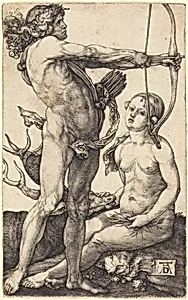
Medium
engraving on laid paper
Dimensions
sheet (trimmed to plate mark): 11.6 x 7.2 cm (4 9/16 x 2 13/16 in.)
Classification
Department
CG-E
Museum
National Gallery of Art, Washington, D.C.
Credit
Rosenwald Collection
Accession Number
1943.3.3486
Rights
Public Domain
Art Historical Context
Behold *Apollo and Diana* (1504/1505), a masterful engraving by Albrecht Der, the preeminent German artist of the Northern Renaissance. This intimate print, measuring just 11.6 x 7.2 cm, captures the sun god Apollo and his sister Diana, goddess of the hunt, in a harmonious classical tableau. Dürer's fascination with antiquity shines through, reflecting his travels to Italy where he absorbed Renaissance ideals of proportion and myth, blending them with Northern precision. Dürer's genius lies in his revolutionary engraving technique on laid paper. Using a burin to incise fine lines into a copper plate, he achieved extraordinary detail—delicate shading, textured foliage, and lifelike figures—that rivaled painting. Prints like this democratized art, allowing wider dissemination across Europe, and this example from the Rosenwald Collection exemplifies his technical mastery. Housed in the National Gallery of Art's Prints department, *Apollo and Diana* embodies the cultural bridge between pagan mythology and Christian humanism. Its small scale belies its monumental impact, inviting you to lean in and marvel at Dürer's enduring legacy in elevating printmaking to high art.
About the Artist
Albrecht Dürer · 1471–1528
Albrecht Dürer (1471–1528) stands as the preeminent figure of the Northern Renaissance and arguably the most influential artist in the history of printmaking. Born in Nuremberg on May 21, 1471, and dying in the same city on April 6, 1528, Dürer revolutionized the status of the artist in Northern Europe, transforming printmaking from a commercial craft into an independent fine art and establishing ...