
Judith
1901
Medium
Öl und Blattgold auf Leinwand
Dimensions
84 × 42 cm
Classification
Gemälde
Department
Belvedere Collection
Museum
Belvedere
Credit
Belvedere, Vienna
Accession Number
4737
Rights
Public Domain
About this artwork
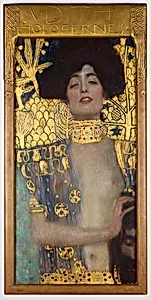
Die Bibelgeschichte der tapferen Judith ist ein häufiges Motiv in der bildenden Kunst. Die keusche Witwe macht den feindlichen Feldherrn Holofernes mit göttlicher Hilfe betrunken und enthauptet ihn anschließend, um ihr Volk zu befreien. Gustav Klimt interpretiert die alttestamentliche Heldin als erotische Femme fatale. Ihr Blick ist lasziv. Die Augen halb geschlossen, der Mund leicht geöffnet. Den abgeschlagenen Kopf des Holofernes erblicken wir erst bei genauem Hinsehen. Fast zärtlich hält Judi...
Art Historical Context
Gustav Klimt's *Judith* (1901), an oil and gold leaf painting on canvas measuring 84 × 42 cm, reimagines a timeless biblical tale from the Book of Judith. In the story, the chaste widow Judith plies the Assyrian general Holofernes wine before beheading him to save her from invasion—a motif beloved in Western art for its drama and themes of heroism and seduction. Created during Klimt's affiliation with the Vienna Secession, which rebelled against conservative academic art, this work exemplifies his Symbolist style, blending eroticism with ornate decoration. Klimt transforms the biblical heroine into a mesmerizing femme fatale, her half-closed eyes and parted lips exuding lascivious intensity. Gold leaf adorns her hair and jewelry, evoking Byzantine mosaics and adding a luminous, otherworldly glow that heightens her sensual power. The severed head of Holofernes appears hidden at first glance, cradled tenderly in her hands as if dismissed from the, shifting focus from violence to Judith's triumphant femininity. Housed in Vienna's Bel Collection, *Judith* captures fin-de-siècle tensions around gender, desire, and politics, recasting a tale of national deliverance as a battle of the sexes. Klimt's bold portrayal cements her as an icon of dangerous allure, inviting viewers to ponder the seductive strength of women in art and history.
About the Artist
Gustav Klimt · 1862–1918
Gustav Klimt was born on July 14, 1862, in Baumgarten near Vienna, the second of seven children in a modest family of artistic bent. His father, Ernst Klimt, a gold engraver who had immigrated from Bohemia, and his mother, Anna Finster, an aspiring musician, instilled an early appreciation for craft and creativity amid financial hardship. Klimt displayed prodigious drawing talent, prompting his en...