
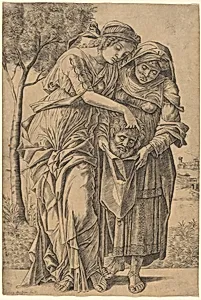
Judith with the Head of Holofernes
c. 1500/1505
Medium
engraving
Dimensions
sheet: 30.9 x 20.9 cm (12 3/16 x 8 1/4 in.)
Classification
Department
CG-E
Museum
National Gallery of Art, Washington, D.C.
Credit
Print Purchase Fund (Rosenwald Collection)
Accession Number
1968.14.1
Rights
Public Domain
Art Historical Context
Behold the dramatic engraving *Judith with the Head Holofernes*, by Girolamo Moc around 1500–1505 after a design by the renowned Renaissance master Andrea Mantegna. This image captures the biblical heroine Judith, who heroically decapitated the Assyrian general Holofernes to her people from siege—a tale from the Book of Judith symbolizing courage, faith, and the triumph of virtue over tyranny. Mocetto, a skilled Venetian engraver, faithfully Mantegna's composition showcasing the master's precise lines, classical proportions, and intense emotional drama characteristic of early Italian Renaissance art. Engravings like this one were revolutionary in the late 15th and early 16th centuries, allowing intricate designs to be mass-produced and widely disseminated across Europe. At 30.9 x 20.9 cm, this sheet exemplifies the medium's technical virtuosity: Mocetto's burin carved fine, cross-hatched details into a copper plate, yielding rich tonal contrasts and textures that mimic Mantegna's painted originals. Housed in the National Gallery of Art's Rosenwald Collection, it highlights how prints bridged elite patronage and broader audiences, making high art accessible. This work not only celebrates a pivotal female figure in Judeo-Christian lore but also reflects the era's fascination with antique heroism and moral storytelling, inviting viewers to ponder themes of justice and resolve that resonate across centuries.