
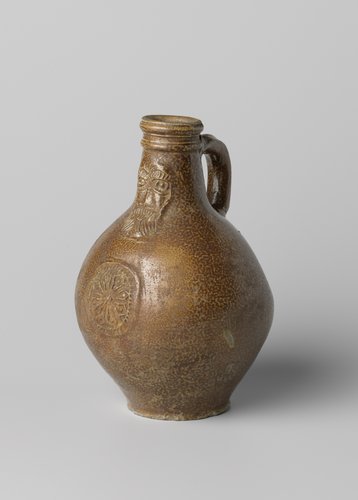
Jug (Bartmann jug) with a roundel in a medallion
ca. 1650 - ca. 1749
Medium
turning
Dimensions
4.3; 22.3; 14.9; 8
Rights
Public Domain
About this artwork
buik: diameter 14,9 cm
Art Historical Context
This charming Bartmann jug dating to around 1650–1749, exemplifies enduring tradition of Rhineland stoneware pottery from. Known as "Bartmannkrüge" or "bearded man j," these vessels were popular across Europe for serving beer, wine, or. Crafted anonymously by skilled potters, this example features a distinctive roundel in a med—likely depicting the iconic bearded face that gives the style its name—applied as a decorative motif, adding whimsy and personality to an everyday object. The jug's medium of "turning" refers to lathe-turning, a precise wheel-throwing technique that allowed potters to refine shapes with exceptional symmetry and smoothness after initial forming. Standing at 22.3 cm tall with a slender diameter of 4.3 cm and a generous belly of 14.9 cm, its balanced proportions made it both functional for the table and visually appealing. Stoneware's salt-glazed surface provided durability and a subtle sheen, ideal for export trade that spread these jugs to households far beyond Germany. Culturally, Bartmann jugs bridged utility and folk art, symbolizing the prosperity of 17th- and 18th-century pottery centers like Raeren and Westerwald. Today, they offer a tangible glimpse into daily life, where craftsmanship met commerce in the Age of Sail.
About the Artist
anonymous
In the vast tapestry of art history, "Anonymous" stands not as a singular individual but as a collective designation for countless unidentified creators whose works have endured across millennia. These artists, spanning prehistoric cave painters to medieval illuminators and folk craftsmen, produced the foundational layers of human visual culture. Prior to the Renaissance, when individual fame emer...