
Jug
c. 1936
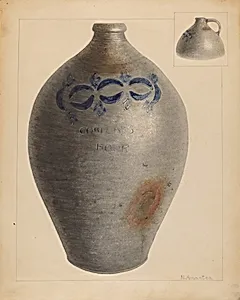
Medium
watercolor and graphite on paperboard
Dimensions
overall: 28.9 x 23.5 cm (11 3/8 x 9 1/4 in.) Original IAD Object: 18" High 6 1/4" Dia(base)
Classification
Index of American Design
Department
CG-W
Museum
National Gallery of Art, Washington, D.C.
Credit
Index of American Design
Accession Number
1943.8.6419
Rights
Public Domain
Art Historical Context
Behold Nicholas Amatea's *Jug* (c. 1936), a captivating watercolor and graphite rendering on paperboard, measuring 28.9 x 23.5 cm. This delicate study captures the form and subtle textures of a traditional American jug, standing 18 inches high with a 6¼-inch base diameter in its original form. Amatea's precise lines and soft washes evoke the jug's earthenware essence, highlighting its practical yet elegant silhouette—a testament to everyday craftsmanship. Created as part of the Index of American Design (IAD), a Federal Art Project under the Works Progress Administration during the Great Depression, this work documents America's rich heritage of folk art and design. From 1935 to 1942, artists like Amatea produced over 15,000 detailed plates of utilitarian objects, preserving cultural artifacts amid economic hardship. Housed in the National Gallery of Art's CG-W department, it reflects the IAD's mission to celebrate democratic design traditions. Amatea's technique—blending graphite's sharp definition with watercolor's luminosity—brings historical objects to life, making the familiar extraordinary. For visitors, it's a window into 1930s America, where art served both preservation and patriotism.
About the Artist
Nicholas Amantea · 1900–1978
Nicholas Amantea (1900–1978) was an American artist born on July 13, 1900, in Pittsburgh, Pennsylvania. His early life and artistic training are not well documented, but by the mid-1930s, he had established himself in New York City, where he contributed significantly to federal art initiatives during the Great Depression. From March 13, 1936, to July 15, 1942, Amantea worked for the Works Progress...