
Jug
c. 1939
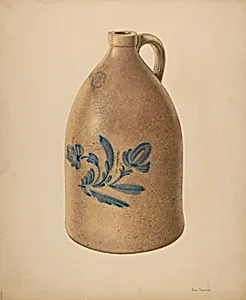
Medium
watercolor, graphite, and colored pencil on paperboard
Dimensions
overall: 45.6 x 55.1 cm (17 15/16 x 21 11/16 in.) Original IAD Object: 19 1/2" High 5 gal. Capacity
Classification
Index of American Design
Department
CG-W
Museum
National Gallery of Art, Washington, D.C.
Credit
Index of American Design
Accession Number
1943.8.7366
Rights
Public Domain
Art Historical Context
This vibrant rendering of a traditional jug, created by artist John Tarantino around 1939, captures the sturdy elegance of American folk craftsmanship. Measuring nearly 18 by 22 inches, the work depicts an original 19½-inch-high vessel with a 5-gallon capacity—likely a utilitarian stoneware jug used for storing liquids like water, whiskey, or cider in rural households. Tarantino's meticulous depiction highlights its robust form, practical spout, and earthen textures, evoking the everyday artistry of 19th-century American potters. As part of the Index of American Design (IAD), a landmark Federal Art Project under the Works Progress Administration (WPA), this piece belongs to a vast archive of over 18,000 watercolor studies documenting America's decorative arts from the 17th to 20th centuries. Launched during the Great Depression, the IAD employed artists like Tarantino to preserve vanishing folk traditions through precise, colorful renderings, ensuring cultural heritage endured amid economic hardship. Tarantino employed watercolor, graphite, and colored pencil on paperboard to achieve lifelike detail and accurate hues, a technique ideal for replicating ceramics' subtle glazes and contours. Housed in the National Gallery of Art, this jug study celebrates the ingenuity of anonymous makers, reminding us how humble objects embody America's inventive spirit.
About the Artist
John Tarantino · 1855–present
John Tarantino was an American artist active from around 1935 to 1953, best known for his meticulous contributions to the Index of American Design, a Federal Art Project under the Works Progress Administration (WPA). This ambitious initiative commissioned artists across the United States to create precise renderings of everyday folk art objects, preserving the nation's vernacular design heritage a...