
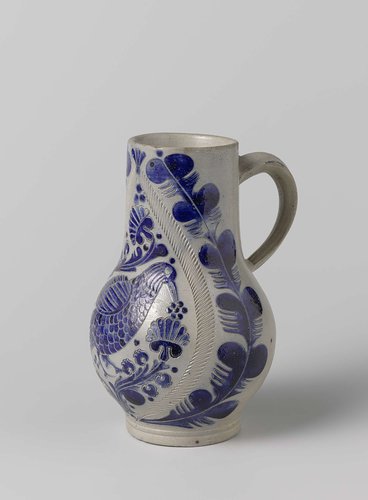
Jug with a bird and flowering plants
c. 1770 - c. 1820
Medium
turning
Dimensions
18.9; 7.2; 14.8; 12; 6.9
Rights
Public Domain
About this artwork
Kruik van steengoed op standring met een peervormig lichaam en brede nek. Het C-vormige oor is bevestigd aan de nek en de schouder. Gedeeltelijk bedekt met kobaltblauw. Op de voorzijde van de kruik een peervormig vak gevormd door ingedrukte zigzaglijnen (knibis). In het vak een in blauw uitgevoerde ingegrifte decoratie van een vogel omringd door bloeiende planten. Gestileerde bladmotieven omvatten het vak. Enkele ingegrifte lijnen op de voet. Westerwald.
Art Historical Context
This elegant stoneware jug, crafted anonymously in the Westerwald region of Germany around 1770–1820, exemplifies the area's renowned pottery tradition. Standing at 18.9 cm high with a 6.9 cm diameter, it features a classic pear-shaped body, wide neck, and foot ring, topped by a sturdy C-shaped handle. Produced on a potter's wheel—a technique known as "turning"—its robust form was ideal for everyday use, such as serving beverages, while its decorative flair elevated it to ornamental status. The jug's artistry shines in its cobalt blue glaze, applied partially for a striking contrast against the gray stoneware. A pear-shaped panel on the front, defined by impressed zigzag lines called *knibis*, frames a sgraffito decoration: a bird surrounded by flowering plants, incised through the slip and filled with blue pigment. Stylized leaves encircle the motif, with subtle incised lines on the foot adding refinement. Sgraffito, a scratching technique revealing the clay beneath, was a hallmark of Westerwald wares, blending functionality with folk artistry. Westerwald stoneware, salt-glazed for durability, flourished in this Rhineland pottery center from the 17th century onward, exporting globally. This jug captures the era's love for nature-inspired motifs, offering a window into 18th–19th-century German craftsmanship—practical yet poetically alive with flora and fauna.
About the Artist
anonymous
In the vast tapestry of art history, "Anonymous" stands not as a singular individual but as a collective designation for countless unidentified creators whose works have endured across millennia. These artists, spanning prehistoric cave painters to medieval illuminators and folk craftsmen, produced the foundational layers of human visual culture. Prior to the Renaissance, when individual fame emer...