
Jug with flower vases
ca. 1680 - ca. 1720
Medium
turning
Dimensions
16.8; 9.1; 14.2; 7.8; 19.2; 16.5
Rights
Public Domain
About this artwork
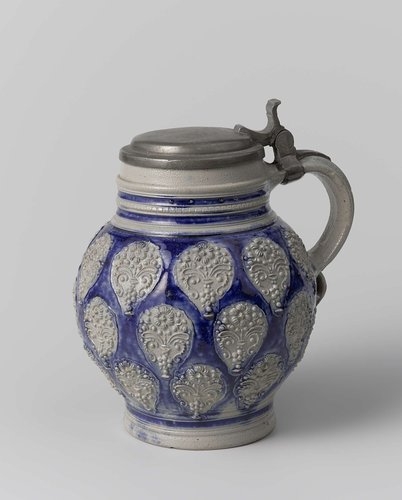
Kan van steengoed met tinnen deksel. De kogelvormige buik is versierd met in rijen geplaatste, in vlak reliëf opgedrukte vazen met bloemen, ongekleurd op een blauwe fond.
Art Historical Context
### Jug with Flower Vasesca. 1680–ca. 1720) This charming anonymous stoneware jug, standing at 19.2 cm tall, exemplifies the robust pottery traditions of late 17th- to early 18th-century Europe. Craft using the wheel-throwing technique—known as "turning"—its bulbous belly swells gracefully, topped with a practical pewter lid for everyday use. The surface bursts with decorative flair: rows of flower-filled vases, stamped in low, flat relief, stand out uncolored against a vivid blue ground, creating a striking contrast that highlights the tactile quality of the clay. Produced during a golden age of stoneware in regions like the Rhineland, this jug reflects the era's blend of functionality and ornamentation. Stoneware's durability made it ideal for household items, while the impressed relief technique allowed potters to add intricate motifs efficiently, mimicking pricier porcelain without the fragility. The floral vase designs evoke the Baroque love for abundance and nature, turning a simple vessel into a subtle conversation piece. Though anonymous, such pieces were likely made in bustling workshops, showcasing skilled artisanship passed down through generations. Imagine it gracing a Dutch or German tavern table, pouring ale amid lively gatherings—a testament to pottery's role in daily life and cultural exchange.
About the Artist
anonymous
In the vast tapestry of art history, "Anonymous" stands not as a singular individual but as a collective designation for countless unidentified creators whose works have endured across millennia. These artists, spanning prehistoric cave painters to medieval illuminators and folk craftsmen, produced the foundational layers of human visual culture. Prior to the Renaissance, when individual fame emer...