
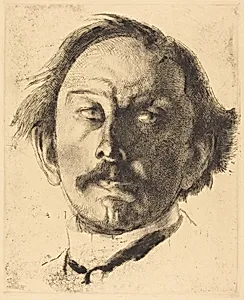
Jules Destrée
1917
Medium
etching and drypoint on BFK Rives laid paper
Dimensions
plate: 30.6 x 24.8 cm (12 1/16 x 9 3/4 in.) sheet: 38.6 x 30.7 cm (15 3/16 x 12 1/16 in.)
Classification
Department
CG-E
Museum
National Gallery of Art, Washington, D.C.
Credit
Gift of Mr. and Mrs. Daniel Bell
Accession Number
1993.71.16
Rights
Public Domain
Art Historical Context
Albert Besnard's *Jules Destrée* (1917) is a striking portrait print capturing the Belgian politician, lawyer, and cultural advocate Jules Destrée, for his fervent defense of Walloon identity and socialist ideals during a turbulent era. Created amid World War I, when Belgium endured German occupation, this etching and drypoint reflects Besnard's mastery as a French artist (1849–1934), for his painterly Symbolist style that emphasized dramatic light, rich textures, and depth—qualities vividly translated into printmaking. The medium shines here: etching provides precise, incised lines etched into a metal plate with acid, while drypoint adds a direct, scratched burr for soft, velvety tones and subtle nuances. Printed on luxurious BFK Rives laid paper—a premium French sheet with its characteristic grid-like texture—this 30.6 x 24.8 cm plate (sheet: 38.6 x 30.7 cm) exemplifies early 20th-century fine art printing, allowing Besnard to achieve painterly effects akin to his oil canvases. Now in the National Gallery of Art's collection (gift of Mr. and Mrs. Daniel Bell), it highlights the era's fusion of politics and portraiture, immortalizing Destrée's resolute gaze as a testament to cultural resilience.
About the Artist
Albert Besnard · 1849–1934
Paul-Albert Besnard, known as Albert Besnard, was born on June 2, 1849, in Paris to an artistic family: his father, Louis Adolphe Ferdinand Besnard, was a history painter and pupil of Ingres, while his mother, Marie Louise Pauline Vaillant, was a noted miniaturist trained under Lizinska de Mirbel. Precociously talented, he began his training under Jean-François Brémond before entering the École de...