
Jupiter and Antiope: Smaller Plate
c. 1631
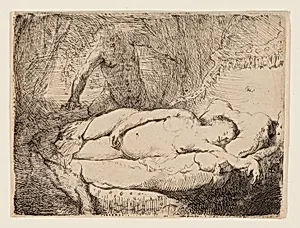
Medium
Etching on buff laid paper
Dimensions
Sheet, trimmed to platemark: 8.4 × 11.4 cm (3 5/16 × 4 1/2 in.)
Classification
etching
Department
Prints and Drawings
Museum
Art Institute of Chicago
Accession Number
49103
Rights
Public Domain
Art Historical Context
Created around 1631, Rembrandt van Rijn’s *Jupiter and Antiope: Smaller Plate* captures a moment from classical mythology in an intimate format. At just over three by four inches, this etching on buff laid paper demonstrates the young artist’s early mastery of printmaking during the Dutch Golden Age. Rembrandt, already exploring dramatic narratives, depicts the god Jupiter approaching the sleeping nymph Antiope, drawing viewers into a scene rich with tension and suggestion. Etching was particularly suited to Rembrandt’s expressive style, allowing him to achieve delicate lines and subtle tonal effects on a small copper plate. This work reflects the seventeenth-century fascination with mythological subjects, which artists used to explore themes of desire, power, and human vulnerability. Though compact in scale, the print reveals Rembrandt’s skill in conveying emotional depth and atmospheric lighting through the medium’s precise yet fluid marks. Housed in the Art Institute of Chicago’s Department of Prints and Drawings, this etching highlights how Rembrandt elevated printmaking from a reproductive technique to a fine art form. Its modest size invites close looking, rewarding visitors with the intricate details that made his early etchings so influential among collectors and fellow artists.
About the Artist
Rembrandt van Rijn · 1606–1669
Rembrandt Harmenszoon van Rijn (1606–1669) stands as one of the greatest visual artists in the history of Western art and the most important Dutch painter of the 17th century. Born in Leiden to a prosperous miller's family, Rembrandt transformed painting through his revolutionary use of light and shadow, his psychological depth in portraiture, and his elevation of etching to a fine art. His approx...