
Jupiter and Callisto
1560/70
Medium
Engraving in black on ivory laid paper
Dimensions
Plate: 18.9 × 28.2 cm (7 1/2 × 11 1/8 in.); Sheet: 21 × 29.7 cm (8 5/16 × 11 3/4 in.)
Classification
engraving
Department
Prints and Drawings
Museum
Art Institute of Chicago
Accession Number
147065
Rights
Public Domain
About this artwork
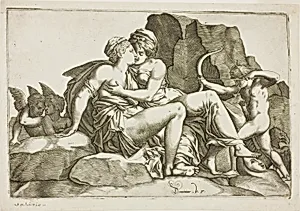
In Roman mythology, Callisto is a nymph of Diana, the goddess of chastity. Jupiter, disguised as Diana and with the help of Cupid, seduces and impregnates Callisto. Domenico Vito, an Italian monk and printmaker, based his Jupiter and Callisto on Pierre Milan’s engraving, after Francesco Primaticcio’s fresco in the Palace of Fontainebleau. Primaticcio was a member of the First School of Fontainebleau, a group of Italian masters brought into France by Francis I to decorate the royal palace. In 15...
Art Historical Context
In the Prints and Drawings department of the Art Institute of Chicago, *Jupiter and Callisto* (c. 1560/70) by Domenico Vito captures a dramatic moment from Ovid's *Metamorphoses*. The engraving depicts the Roman god Jupiter, disguised as Diana, seducing the nymph Callisto—a tale of divine deception and tragic transformation that captivated Renaissance artists. Vito, a 16th-century Italian engraver, renders this mythological narrative with intricate line work, emphasizing the tension between divine power and mortal vulnerability. Crafted as an engraving in black ink on luxurious ivory laid paper (plate: 18.9 × 28.2 cm), the work exemplifies the technical precision of intaglio printmaking. Vito's burin incised fine lines into a copper plate, allowing ink to cling to the grooves for rich, tonal depth when printed under pressure. This medium was revolutionary in the mid-16th century, democratizing access to complex compositions originally painted for elite patrons and fostering the spread of Mannerist styles across Europe. As a product of the late Renaissance, the print reflects the era's obsession with classical antiquity, blending eroticism and moral allegory. Its modest scale belies its cultural impact, inviting collectors to ponder themes of fate and desire in an intimate format perfect for scholarly contemplation.