
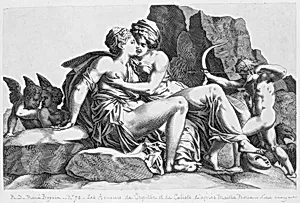
Jupiter and Callisto
Medium
Engraving
Dimensions
sheet: 7 1/16 x 11 3/16 in. (18 x 28.4 cm)
Classification
Prints
Department
Drawings and Prints
Museum
Metropolitan Museum of Art, New York, NY
Credit
Harris Brisbane Dick Fund, 1932
Accession Number
32.92.27(19)
Rights
Public Domain
Tags
Art Historical Context
This engraving of *Jupiter and Callisto*, created between 1537 and 1540, captures a lively mythological scene drawn from classical sources. Designed by the Italian artist Francesco Primaticcio and engraved by Pierre Milan, the work reflects the elegant, elongated figures and graceful compositions characteristic of the School of Fontainebleau. Primaticcio, who worked extensively for the French court of Francis I, helped introduce Italian Mannerist sensibilities to France, blending them with local traditions to produce refined decorative art. The medium of engraving was especially significant during the Renaissance, allowing intricate designs to be reproduced and shared widely across Europe. Here, the delicate lines render the drama of Jupiter’s pursuit—accompanied by Cupid with bow and arrow—amid a group of nymphs, emphasizing both narrative tension and decorative beauty. Measuring just over seven by eleven inches, the print exemplifies how such works served both as independent artworks and as models for painters and craftsmen. Housed in the Metropolitan Museum of Art’s Department of Drawings and Prints, this piece highlights the era’s fascination with classical mythology and the technical mastery of printmaking, inviting viewers to appreciate the interplay of story, style, and craftsmanship from the sixteenth century.
About the Artist
Francesco Primaticcio|Pierre Milan · 1504–1570
Primaticcio was the most influential Italian artist in France in the 16th century. Together with Rosso Fiorentino they created a style of mixing stucco decoration with mannerist paintings that became known as the Fontainebleau school. Italian painter, architect and sculptor. Comment on works: Religious; Allegory; History.