
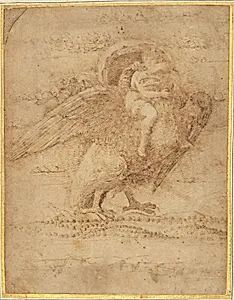
Jupiter and Ganymede Above an Extensive Landscape
Medium
pen and brown ink on laid paper, the two figures (only) incised (laid on late eighteenth/early nineteenth-century mount)
Dimensions
overall: 15.2 × 11.9 cm (6 × 4 11/16 in.)
Classification
Drawing
Department
CG-E
Museum
National Gallery of Art, Washington, D.C.
Credit
Ailsa Mellon Bruce Fund
Accession Number
1996.11.1
Rights
Public Domain
Art Historical Context
Behold the delicate mastery of *Jupiter and Ganymede an Extensive Landscape*, a and brown ink drawing from the 0s, attributed to Giovanni Bellini or Andreaantegna—two titans of the early Renaissance whose styles intertwined through family ties and shared innovations. Depicting the classical myth of Jupiter transforming into an eagle to abduct the youth Ganymede, the floats the figures ethereally above a vast, detailed panorama, blending human drama with nature's grandeur. At just 15.2 × 11.9 cm, its intimate scale invites close inspection, revealing the artists' precision in capturing movement and depth. Crafted on laid paper, the work's standout feature is the incising of the two figures alone—a technique used to transfer outlines onto another surface, likely for a painting, fresco, or print. This preparatory drawing exemplifies Renaissance draftsmanship, where pen lines in brown ink build texture and form with economical grace. Bellini, a Venetian pioneer of oil painting and atmospheric light, or Mantegna, famed for his archaeological precision and dramatic foreshortening, would have prized such studies for their role in workshop practice. Acquired through the Ailsa Mellon Bruce Fund for the National Gallery of Art's collection (Department CG-E), this gem underscores the era's revival of antiquity, infusing Christian art traditions with pagan vitality. It offers a window into how 15th-century Italian masters harmonized myth, landscape, and technique to evoke wonder.